How Much Income You Need to Buy a Home in Seattle Metro Neighborhoods

Buying a home in the Seattle metro area has become one of the biggest financial hurdles for middle-class households. While housing prices have cooled slightly from pandemic peaks, the city remains one of the most expensive real estate markets in the United States.
As of early 2026, the average home value in Seattle is around $830K+, while typical sale prices often hover between $785K and $870K depending on the dataset and property type.
But home prices alone don’t tell the full story. What really matters for buyers is the income required to comfortably afford those homes.
This analysis estimates the annual household income needed to buy a home across Seattle metro neighborhoods in 2026, using common affordability assumptions.
If you want a deeper look at what salaries actually feel like in the city, see our guide:
What Income Actually Feels Comfortable in Seattle in 2026.
Methodology: How Income Needed Was Estimated
The income estimates below use a common affordability framework used by mortgage lenders and housing researchers:
- 20% down payment
- 30-year fixed mortgage
- Mortgage rates around ~6%
- Housing costs capped at roughly 30% of gross household income
- Includes property tax and insurance estimates typical for King County
These assumptions follow the widely used housing affordability rule where housing expenses should not exceed about 30% of income.
Across the Seattle metro area, the typical household income required to buy a home is now estimated around $190K+, while the median household income is closer to $124K.
This affordability gap explains why many residents continue renting rather than buying.
For a broader look at salary purchasing power across the country, see:
Paycheck Power: What Your Salary Really Feels Like by City (2026).
Income Needed to Buy a Home in Seattle Metro Neighborhoods
The table below compares typical home values with estimated annual income required to comfortably afford a home in various Seattle metro neighborhoods.
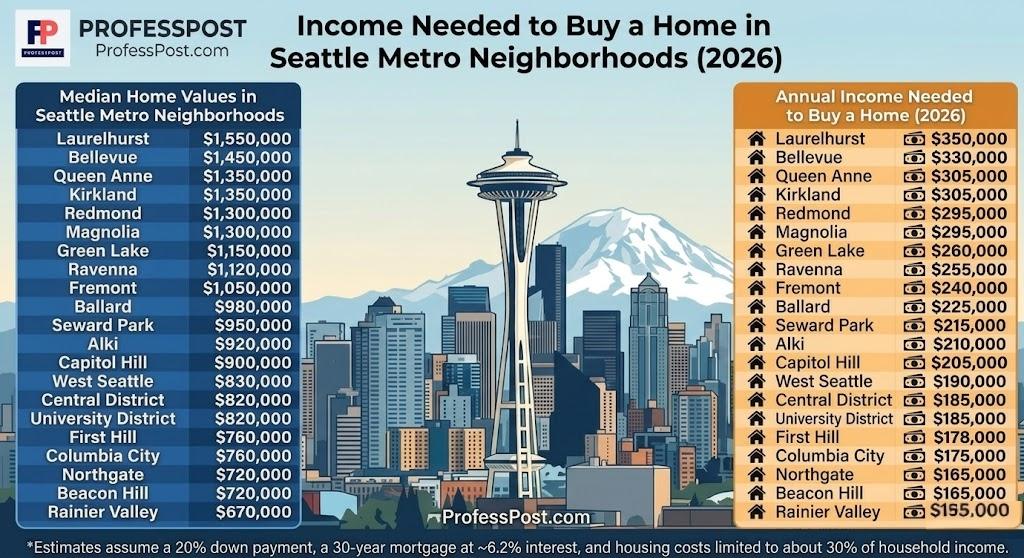
| Neighborhood | Median Home Value | Annual Income Needed |
|---|---|---|
| Ballard | $980,000 | $225,000 |
| Green Lake | $1,150,000 | $260,000 |
| Fremont | $1,050,000 | $240,000 |
| Northgate | $720,000 | $165,000 |
| Ravenna | $1,120,000 | $255,000 |
| Capitol Hill | $900,000 | $205,000 |
| Central District | $820,000 | $185,000 |
| First Hill | $780,000 | $178,000 |
| Queen Anne | $1,350,000 | $305,000 |
| Magnolia | $1,300,000 | $295,000 |
| West Seattle | $830,000 | $190,000 |
| Alki | $920,000 | $210,000 |
| Beacon Hill | $720,000 | $165,000 |
| Columbia City | $760,000 | $175,000 |
| Rainier Valley | $670,000 | $155,000 |
| Seward Park | $950,000 | $215,000 |
| University District | $820,000 | $185,000 |
| Laurelhurst | $1,550,000 | $350,000 |
| Bellevue | $1,450,000 | $330,000 |
| Redmond | $1,300,000 | $295,000 |
| Kirkland | $1,350,000 | $305,000 |
The Seattle Affordability Gap
The biggest takeaway from this data is the growing affordability gap between incomes and home prices.
In many neighborhoods, buyers now need household incomes well above $200K per year to comfortably purchase a home. That is far above the typical household income in the region.
This gap has been widening nationwide as home prices have increased far faster than incomes over the past two decades.
Seattle’s strong tech economy and limited housing supply have amplified this trend.
If you’re curious how wealth actually looks in the region, read our analysis:
How Wealth Looks in Seattle: What It Really Takes to Reach the Top 10%.
Why Seattle Housing Costs Remain So High
Several structural factors continue to drive high housing costs in the Seattle metro area:
- Strong demand from high-income tech workers
- Limited land supply due to geography and zoning
- Slow housing construction relative to population growth
- High property values in established neighborhoods
Even when home prices stabilize, affordability can still remain difficult for middle-income households.
Renting remains the more accessible option for many residents. For a national comparison, see our analysis of housing affordability across the country:
Rent-to-Income Ratio in the 30 Largest U.S. Cities.
Bottom Line
Seattle remains one of America’s most challenging housing markets for buyers.
While some neighborhoods remain relatively more accessible than others, the reality is that many Seattle metro homes now require incomes above $200K to purchase comfortably.
For prospective buyers, understanding neighborhood-level affordability can help clarify where homeownership may still be within reach.
As mortgage rates and wages evolve in the coming years, the balance between income and housing costs will continue to shape who can afford to live in Seattle.