Income Needed to Buy a Home in San Francisco by Neighborhood (2026)
San Francisco has one of the most expensive housing markets in the United States. High salaries in the technology and finance sectors often create the perception that homeownership should be attainable for many residents. In reality, rising home prices mean that even high-income households often struggle to purchase property in the city.
According to housing data from Zillow, the typical home value in San Francisco is around $1.25 million, while median sale prices often exceed $1.3 million depending on market conditions.
Because of these high prices, the income required to buy a home varies dramatically depending on the neighborhood. Some areas require well over $400,000 in annual income to purchase property comfortably, while more affordable neighborhoods still require incomes far above the national average.
Key Takeaways
- The average home value in San Francisco is roughly $1.25M.
- Many neighborhoods require $200K+ household income to buy a home.
- Luxury areas like Pacific Heights can require incomes above $400K.
- Even relatively affordable neighborhoods still require six-figure incomes.
Income Needed to Buy a Home in San Francisco Neighborhoods
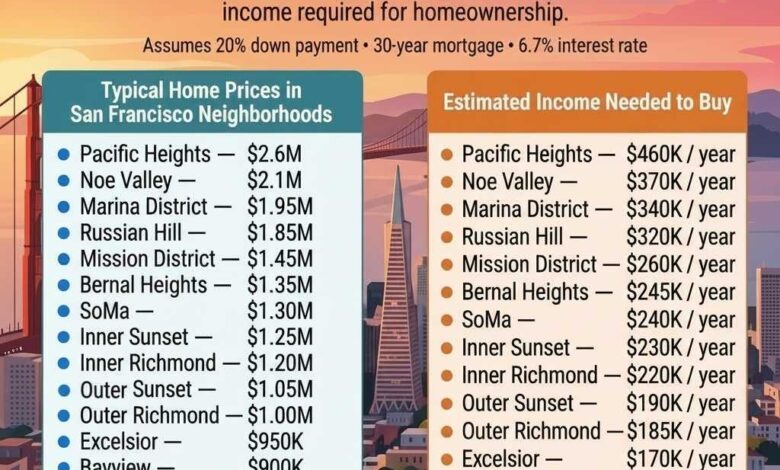
The table below estimates the household income needed to purchase homes across different San Francisco neighborhoods. Estimates assume a typical mortgage structure with a 20% down payment and a 30-year mortgage.
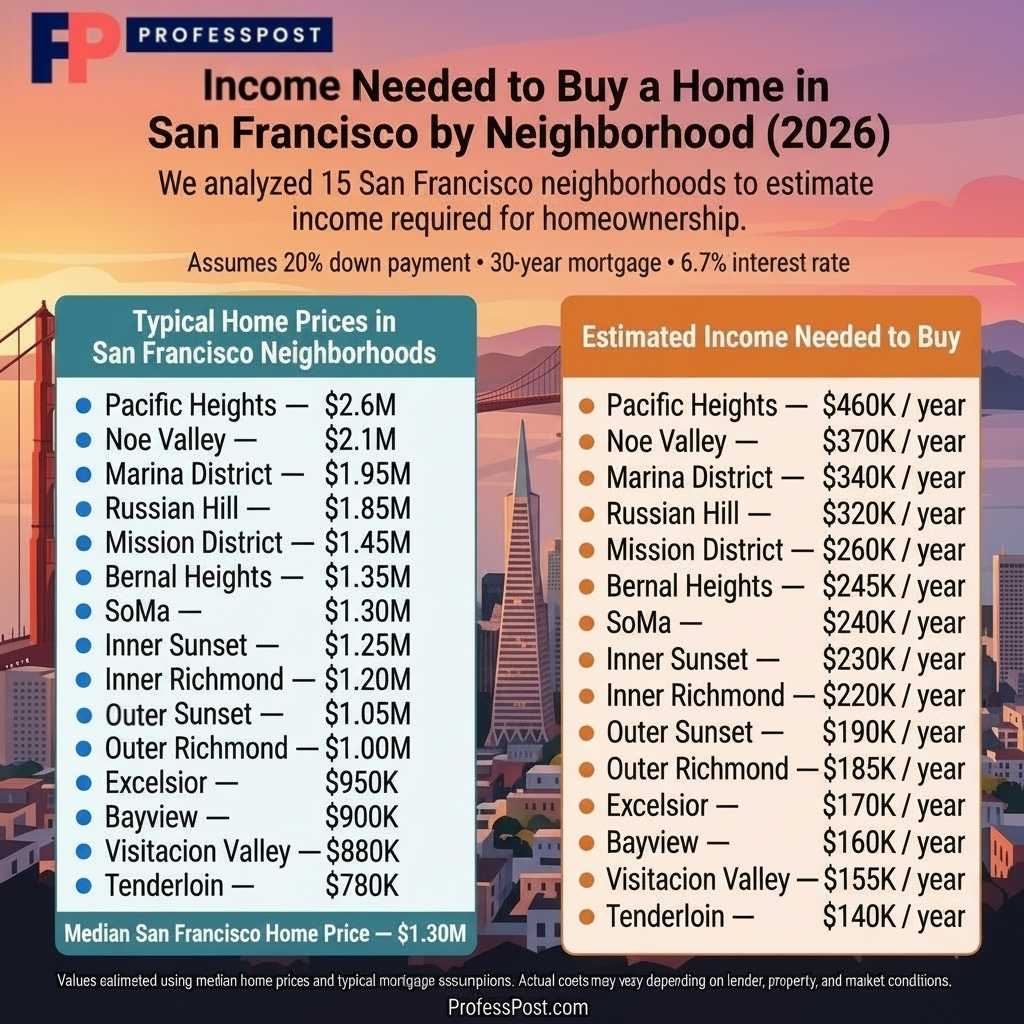
Data Visualization by Professpost.com
| Neighborhood | Typical Home Price | Estimated Income Needed |
|---|---|---|
| Pacific Heights | $2.6M | $460K+ |
| Noe Valley | $2.1M | $370K+ |
| Marina District | $1.95M | $340K+ |
| Russian Hill | $1.85M | $320K+ |
| Mission District | $1.45M | $260K+ |
| Bernal Heights | $1.35M | $245K+ |
| SoMa | $1.30M | $240K+ |
| Inner Sunset | $1.25M | $230K+ |
| Inner Richmond | $1.20M | $220K+ |
| Outer Sunset | $1.05M | $190K+ |
| Outer Richmond | $1.00M | $185K+ |
| Excelsior | $950K | $170K+ |
| Bayview | $900K | $160K+ |
| Visitacion Valley | $880K | $155K+ |
| Tenderloin | $780K | $140K+ |
Why Buying a Home in San Francisco Requires Such High Income
Several structural factors keep San Francisco housing prices among the highest in the country. Limited land, strict zoning rules, and long housing approval processes have historically restricted supply. Some city permitting processes have taken nearly a year in the past, significantly slowing construction and limiting new housing availability.
At the same time, strong demand from high-earning workers in technology and finance has kept prices elevated. In some luxury districts like Pacific Heights and the Marina, homes frequently sell well above national price averages, often attracting wealthy buyers and cash offers.
Renting vs Buying in San Francisco
The decision to buy a home versus renting has become more complex in recent years. Median rent in San Francisco can exceed $4,000 per month depending on unit size and location.
For many households, renting may be financially easier in the short term, while buying requires substantial savings for down payments that can exceed $250,000 for many properties.
To explore the rental affordability side of the market, see our analysis of:
- San Francisco Rent-to-Income Ratio by Neighborhood
- Rent-to-Income Ratio in the 30 Largest U.S. Cities
How Housing Costs Fit Into the Bigger Financial Picture
Housing affordability is only one piece of the broader financial picture for residents. Many households must balance mortgage costs with taxes, transportation, childcare, and other major expenses.
To understand how income levels translate into real purchasing power across cities, see our analysis of:
For readers interested in wealth distribution across neighborhoods, these analyses provide additional context:
The Bottom Line
San Francisco remains one of the most expensive housing markets in the United States. While high salaries are common in certain industries, homeownership still requires significantly higher income levels than most American cities.
For many residents, neighborhood choice can dramatically change affordability. Buyers willing to look beyond the most expensive districts may find opportunities in more affordable areas, though home prices across the city remain far above the national average.
Sources: Zillow Housing Data, Realtor.com Market Reports, local San Francisco housing market analyses.
Author: Max Forsberg
Housing data researcher focused on housing affordability, wealth distribution, and real estate trends across major U.S. cities.