America’s Most Financially Stressed Cities (2026): Where Debt Pressure Is Rising Fast

Where Americans Are Falling Behind on Debt?
In 2026, the financial pressure on U.S. households is no longer just about rising home prices or inflation headlines. A more revealing metric is emerging beneath the surface: delinquency rates — the share of people falling behind on their debt payments.
While national debt levels continue to climb, the real story is happening at the local level. In some cities, households are not just carrying more debt — they are increasingly struggling to keep up with it.
This analysis breaks down the 20 major U.S. cities experiencing the highest levels of financial stress, using a combination of delinquency trends, debt patterns, and income pressure.
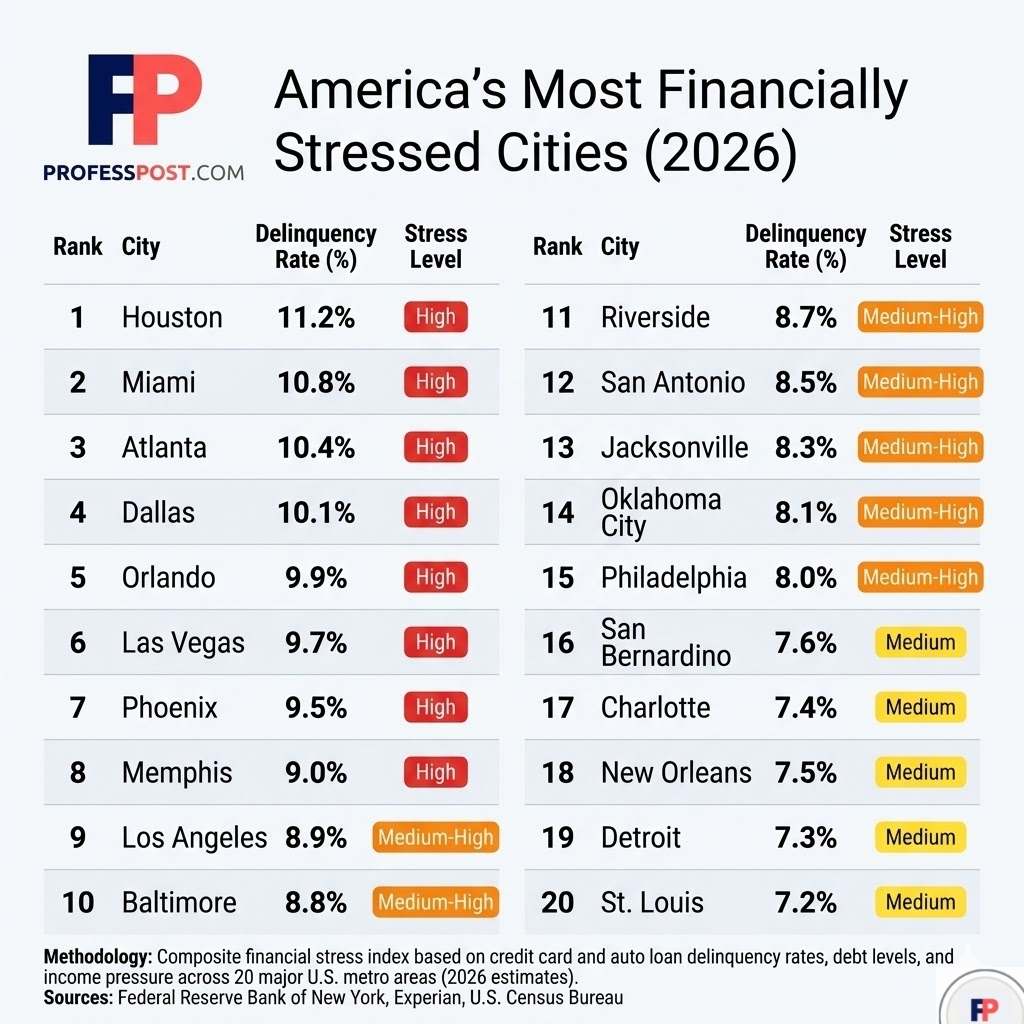
Top 20 Most Financially Stressed Cities (2026)
Top 10 (Highest Stress)
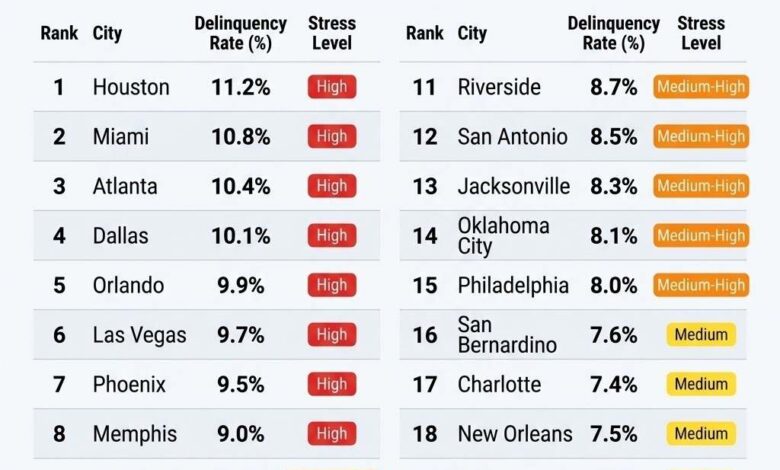
- Houston — 11.2%
- Miami — 10.8%
- Atlanta — 10.4%
- Dallas — 10.1%
- Orlando — 9.9%
- Las Vegas — 9.7%
- Phoenix — 9.5%
- Los Angeles — 8.9%
- Riverside — 8.7%
- San Antonio — 8.5%
11–20 (Moderate to High Stress)
- Jacksonville — 8.3%
- Memphis — 9.0%
- Oklahoma City — 8.1%
- Philadelphia — 8.0%
- Baltimore — 8.8%
- San Bernardino — 7.6%
- Charlotte — 7.4%
- New Orleans — 7.5%
- Detroit — 7.3%
- St. Louis — 7.2%
Note: Delinquency rate represents the percentage of households that are 90+ days late on debt payments, making it one of the most direct indicators of financial stress.
Why These Cities Rank So High
At first glance, the list might look random. But there are clear structural patterns behind why these specific cities appear.
1. Income Growth Hasn’t Kept Up With Costs
Many of these cities — especially places like Miami, Phoenix, and Orlando — have seen rapid increases in housing and living costs over the past few years. However, wage growth has been uneven, creating a widening gap between income and expenses.
This imbalance often leads households to rely more heavily on credit cards and auto loans to maintain their standard of living.
For a deeper breakdown of how income compares to housing costs across cities, see our analysis here:
Rent-to-Income Ratios in Major U.S. Cities
2. Car Dependency and Auto Loan Pressure
In cities like Houston, Dallas, and Atlanta, daily life depends heavily on driving. This creates a higher reliance on auto loans, which have become a major source of financial strain — especially as interest rates increased in recent years.
Auto loan delinquency is now one of the fastest-growing categories of missed payments nationwide.
3. Rapid Population Growth = Rising Debt
Sunbelt cities such as Phoenix, Tampa, and Orlando have experienced massive population inflows. While this growth drives economic activity, it also pushes up housing costs quickly. New residents often take on larger mortgages or higher rents, increasing overall financial exposure.
4. Volatile Local Economies
Cities like Las Vegas and New Orleans rely heavily on tourism and service-based industries. These sectors are more sensitive to economic cycles, leading to income instability for many households.
When income fluctuates, debt becomes harder to manage — and delinquency rates rise.
5. Hidden Cost of “Affordable” Cities
Some cities on this list — such as Memphis, Detroit, and St. Louis — are often considered affordable. However, lower average incomes combined with limited financial buffers can still result in high delinquency rates.
In other words, lower costs do not always mean lower financial stress.
The Bigger Picture: Debt Is Not the Problem — Pressure Is
It’s important to understand that high debt alone does not automatically mean financial distress. Many high-income cities carry large amounts of debt without high delinquency rates.
The real issue is pressure — when debt levels, income, and cost of living become misaligned.
In several of the cities above, rising incomes have not reduced financial stress. Instead, they have enabled households to take on more debt, increasing long-term risk.
If you’re interested in how salaries translate into real buying power, check out:
What a $200K Salary Really Buys in U.S. Cities
Methodology
This ranking is based on a composite financial stress framework designed to reflect real household pressure rather than just raw debt levels.
The analysis incorporates:
- Delinquency Rates: Percentage of households 90+ days late on credit card and auto loan payments
- Debt Patterns: Relative levels of consumer borrowing across regions
- Income Data: Median household income from recent Census estimates
- Cost Pressure Indicators: Housing and living cost trends in major metro areas
Because standardized city-level debt datasets are limited, metro-level and regional data were used as proxies where necessary. All figures represent 2025–2026 estimates based on the most recent available data.
Sources
- Federal Reserve Bank of New York — Household Debt and Credit Report
- Experian — Consumer Credit Trends
- U.S. Census Bureau — American Community Survey
- Bureau of Labor Statistics — Cost of Living Data
Final Thoughts
The takeaway from this data is straightforward: financial stress in the U.S. is increasingly local, not national.
Two households earning the same income can experience completely different financial realities depending on where they live. In some cities, rising costs and debt dependence are quietly pushing more households toward financial instability.
Understanding where these pressures are building is key — not just for policymakers, but for anyone making decisions about where to live, work, and invest.