How Far Does a $150,000 Salary Stretch in Dallas? A Real Cost of Living Breakdown (2026)

Dallas has become one of America’s fastest-growing metro areas. With a booming job market, no state income tax, and relatively moderate housing costs compared to coastal cities, many professionals wonder the same thing:
How far does a $150,000 salary actually go in Dallas in 2026?
The answer depends heavily on where you live and whether you rent or own a home. Neighborhood choice can change your monthly disposable income by thousands of dollars.
This guide breaks down:
- Typical monthly expenses in Dallas
- Renting vs homeownership costs
- Neighborhood-by-neighborhood disposable income
- Real housing market data for 2026
If you want a broader look at how salaries feel across U.S. cities, you may also find this useful:
Paycheck Power: What Your Salary Really Feels Like by City.
The Dallas Cost of Living Snapshot (2026)
Dallas remains slightly cheaper than the U.S. average in overall cost of living, largely because Texas has no state income tax. However, housing prices and rents have risen significantly in the past decade.
As of 2026:
- Median home price in Dallas: ~$375,000
- Typical 1-bedroom rent: $1,380–$1,540/month
- Average rent across all properties: around $1,975/month
Housing costs vary dramatically by neighborhood. Upscale areas like Uptown or Lakewood are far more expensive than suburban areas such as Irving or Plano.
Estimated Take-Home Pay on a $150K Salary
For a single filer living in Texas:
- Gross salary: $150,000
- Estimated monthly take-home pay after federal taxes and payroll taxes: ~$9,400
This estimate assumes no additional deductions beyond the standard deduction.
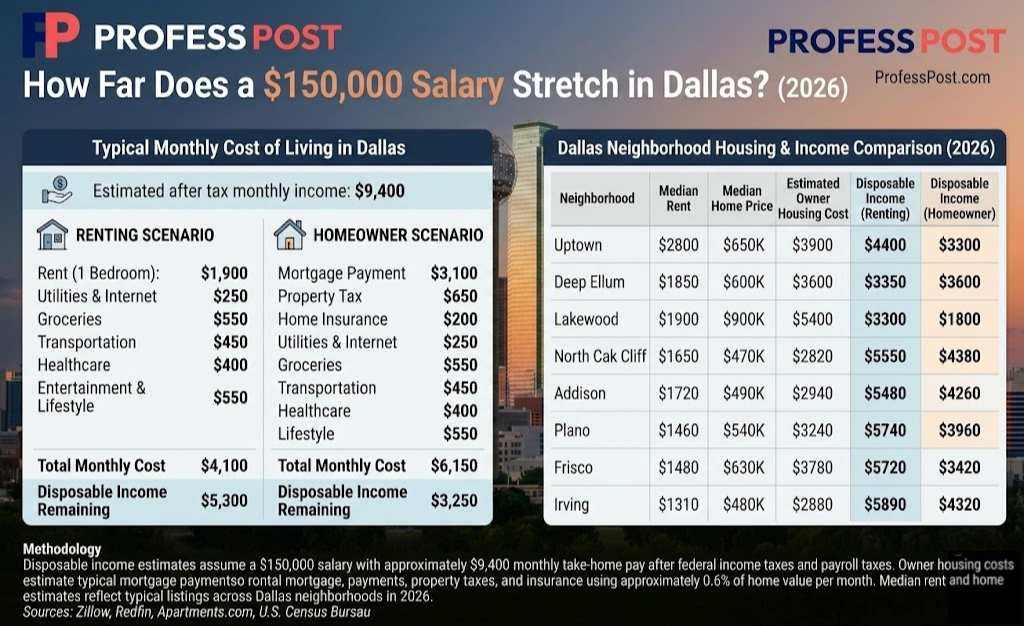
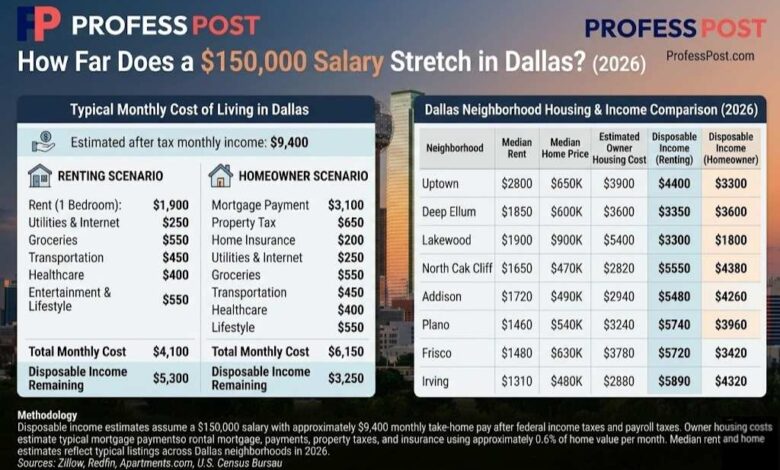
Graphic by Professpost.com
Typical Monthly Living Costs in Dallas
Beyond housing, a typical monthly budget for a single professional might look like this:
| Expense | Monthly Cost |
|---|---|
| Utilities & Internet | $250 |
| Groceries | $550 |
| Transportation | $450 |
| Healthcare | $400 |
| Entertainment & Lifestyle | $550 |
| Total Non-Housing Costs | $2,200 |
Renting vs Owning: Monthly Budget Comparison
Scenario 1: Renting
| Category | Monthly Cost |
|---|---|
| Rent (1 Bedroom) | $1,900 |
| Other Living Expenses | $2,200 |
| Total Monthly Cost | $4,100 |
| Disposable Income Remaining | $5,300 |
Scenario 2: Homeowner
| Category | Monthly Cost |
|---|---|
| Mortgage Payment | $3,100 |
| Property Tax | $650 |
| Insurance | $200 |
| Other Living Expenses | $2,200 |
| Total Monthly Cost | $6,150 |
| Disposable Income Remaining | $3,250 |
Owning a home offers long-term equity, but it significantly reduces short-term disposable income compared to renting.
Neighborhood Comparison: Where $150K Goes the Furthest
| Neighborhood | Median Rent | Median Home Price | Disposable Income (Rent) | Disposable Income (Owner) |
|---|---|---|---|---|
| Uptown | $2,800 | $625K | $4,400 | $3,300 |
| Deep Ellum | $1,850 | $600K | $5,350 | $3,600 |
| Lakewood | $1,900 | $900K+ | $5,300 | $1,800 |
| North Oak Cliff | $1,650 | $470K | $5,550 | $4,380 |
| Addison | $1,720 | $490K | $5,480 | $4,260 |
| Plano | $1,460 | $540K | $5,740 | $3,960 |
| Frisco | $1,480 | $630K | $5,720 | $3,420 |
| Irving | $1,310 | $480K | $5,890 | $4,320 |
For renters, suburban areas like Irving, Plano, and Frisco often leave significantly more disposable income each month.
But if you’re planning to buy property, neighborhoods with lower home prices such as North Oak Cliff or Irving offer much more financial flexibility.
Why Housing Costs Vary So Much Across Dallas
Dallas neighborhoods differ widely in lifestyle and property type.
- Uptown – dense urban condos and luxury apartments
- Lakewood – large single-family homes near White Rock Lake
- Frisco & Plano – suburban master-planned communities
- North Oak Cliff – rapidly gentrifying area with historic homes
For example, median home prices in Lakewood recently exceeded $1.6 million as demand surged for properties near the lake.
Is $150K Considered a High Salary in Dallas?
Compared to the local median household income, a $150K salary is well above average. However, housing costs can quickly change how comfortable that income feels depending on your neighborhood and housing choice.
If you’re curious how wealth compares locally, see:
What It Takes to Reach the Top 10% of Household Net Worth in Dallas
How Dallas Compares to Other U.S. Cities
Dallas generally offers a better salary-to-cost ratio than cities like New York, Los Angeles, or San Francisco.
But housing affordability still varies significantly across the metro area.
You may also want to explore:
- Rent-to-Income Ratio in the 30 Largest U.S. Cities
- Dallas–Fort Worth Rent-to-Income Ratio by Neighborhood
- NYC Rent to Income Ratio by Neighborhood 2026
- San Francisco Rent-to-Income Ratio by Neighborhood 2026
Final Takeaway
A $150,000 salary goes a long way in Dallas—but where you live makes a huge difference.
- Renters can keep $5,000+ per month in many neighborhoods
- Homeowners may have closer to $3,000–$4,000 remaining
- Luxury neighborhoods can dramatically reduce disposable income
Dallas still offers one of the strongest combinations of job growth, housing supply, and tax advantages among major U.S. metros.
Choosing the right neighborhood can easily change your financial flexibility by $2,000 per month or more.
For a deeper look at wealthy areas across the state, see:
Richest Neighborhoods in Texas (2026)
Sources & Data
- Zillow – Dallas housing market data and typical home values
https://www.zillow.com/home-values/38128/dallas-tx/
- RentCafe – Dallas apartment rent trends and market analysis
https://www.rentcafe.com/average-rent-market-trends/us/tx/dallas/
- Apartments.com – Average apartment rent and housing cost data
https://www.apartments.com/rent-market-trends/dallas-tx/
- U.S. Census Bureau – Housing, renter-occupied households, and demographic data
https://www.census.gov/
- ManageCasa – Texas housing market overview and median home price estimates
https://managecasa.com/articles/texas-housing-market