How Much You Need to Earn to Live Alone in U.S. Cities (2026)

Salary Needed to Live Alone in US cities 2026
Living alone used to be a milestone. In 2026, it’s increasingly becoming a financial stretch, especially in major U.S. cities.
Rents have climbed faster than wages in many markets, and the cost of everyday essentials hasn’t exactly cooled off either. The result? The income needed to comfortably live alone now varies dramatically depending on where you are.
In this guide, we break down how much you actually need to earn to live alone in 10 major U.S. cities, using real rent estimates, cost-of-living data, and a simple but widely accepted budgeting rule.
The Rule Behind the Numbers
To keep things consistent, we used the standard 30% rent rule. That means your monthly rent should not exceed 30% of your gross income.
For example:
- $2,000 rent → ~$80,000 annual income needed
- $3,000 rent → ~$120,000 annual income needed
On top of that, we estimated basic monthly living costs (groceries, utilities, transportation, insurance, etc.) to reflect a realistic solo lifestyle, not just survival.
Salary Needed to Live Alone in Major U.S. Cities (2026)
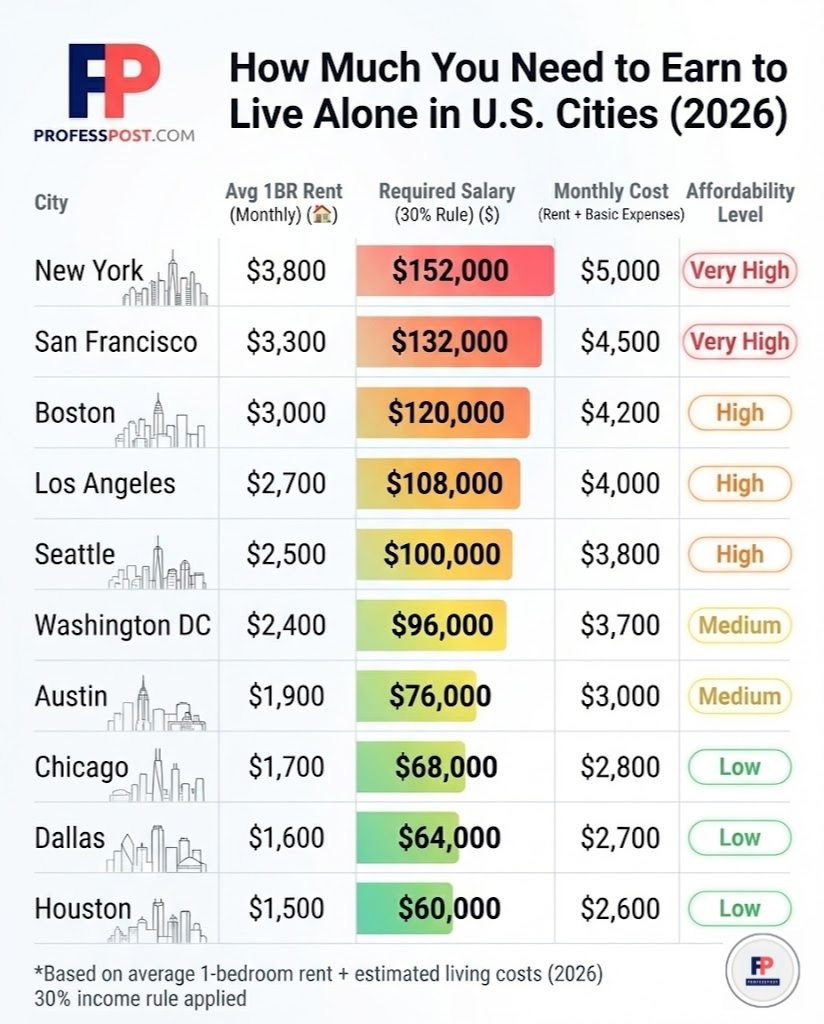
| City | Avg 1BR Rent | Required Salary | Est. Monthly Cost | Affordability |
|---|---|---|---|---|
| New York, NY | $3,800 | $152,000 | $5,000 | Very High |
| San Francisco, CA | $3,300 | $132,000 | $4,500 | Very High |
| Boston, MA | $3,000 | $120,000 | $4,200 | High |
| Los Angeles, CA | $2,700 | $108,000 | $4,000 | High |
| Seattle, WA | $2,500 | $100,000 | $3,800 | High |
| Washington, DC | $2,400 | $96,000 | $3,700 | Medium |
| Austin, TX | $1,900 | $76,000 | $3,000 | Medium |
| Chicago, IL | $1,700 | $68,000 | $2,800 | Low |
| Dallas, TX | $1,600 | $64,000 | $2,700 | Low |
| Houston, TX | $1,500 | $60,000 | $2,600 | Low |
What Stands Out
The gap between cities is hard to ignore. In New York, you’re realistically looking at a six-figure salary just to live alone without stretching your finances. In Houston, that number drops to around $60K.
That’s not just a small difference—it’s a completely different financial reality.
Even within the same country, your lifestyle depends heavily on geography. A $100K salary might feel tight in San Francisco, but comfortable in Chicago.
The “Living Alone Premium”
Living alone comes with hidden costs that aren’t always obvious at first:
- No shared rent or utilities
- Higher per-person grocery costs
- Single-income financial pressure
- Less flexibility during economic downturns
This is often referred to as the “singles tax”—and over time, it adds up.
Why Costs Are So Different Across Cities
There are a few key reasons why some cities demand much higher incomes:
1. Housing Supply vs Demand
In cities like New York, Boston, and San Francisco, demand continues to outpace supply—keeping rents elevated.
2. Local Income Levels
High-paying industries (tech, finance, government) push prices up. Landlords price units based on what top earners can afford.
3. Infrastructure & Lifestyle Costs
Transportation, taxes, insurance, and even food costs vary widely depending on the city.
Where Living Alone Is Still Realistic
If your goal is independence without a six-figure salary, certain cities still offer a path:
- Houston
- Dallas
- Chicago
- Mid-sized Midwest cities
These markets tend to have lower rent-to-income ratios and more housing availability.
Final Thoughts
Living alone in 2026 isn’t impossible—but it does require planning.
For most people:
- $60K–$70K → entry-level solo living (affordable cities)
- $90K–$110K → comfortable in many metros
- $120K–$150K+ → necessary in top-tier cities
At the end of the day, your income matters—but where you choose to live matters just as much.
Methodology
This analysis is based on a combination of rental market data, cost-of-living estimates, and standard financial planning benchmarks.
We used the 30% rent-to-income rule to calculate the minimum recommended salary required to afford a one-bedroom apartment in each city.
Average rent figures reflect 2025–2026 market estimates for centrally located one-bedroom units in major metro areas.
Monthly cost estimates include:
- Utilities (electricity, water, internet)
- Groceries and basic food expenses
- Transportation (public transit or car-related costs)
- Health insurance and miscellaneous essentials
These estimates are intended to represent a realistic, moderate lifestyle—not luxury spending, but not bare-minimum survival either.
Sources
- RentCafe – U.S. Rental Market Trends
- ApartmentAdvisor – National Rent Report
- Numbeo – Cost of Living Data
- U.S. Bureau of Labor Statistics (BLS)
- Federal Reserve Economic Data (FRED)
Note: All figures are estimates based on available 2026 data and may vary depending on neighborhood, lifestyle, and market changes.