What a $200K Salary Really Buys in 10 Bay Area Cities (2026)

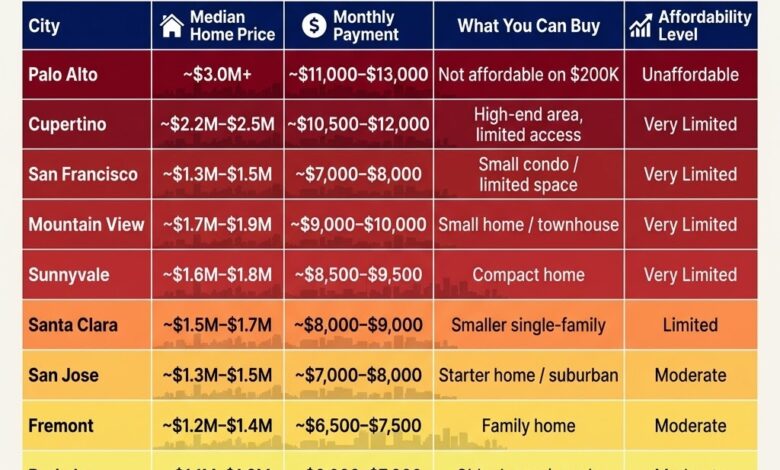
How Far a $200K Salary Goes in 10 Bay Area Cities (2026)
From San Francisco to Silicon Valley, a $200K salary can mean completely different lifestyles depending on where you live.
Across the United States, a $200,000 income is often associated with financial security and upward mobility. But in the Bay Area — one of the most expensive housing markets in the world — that same income can feel surprisingly constrained.
Here’s a closer look at how far a $200K salary really goes across 10 core Bay Area cities — from housing costs to everyday affordability and what that income actually means on the ground in 2026.
Bay Area Housing Market in 2026: Key Context
The Bay Area housing market remains one of the most competitive and supply-constrained regions in the country. Median home prices continue to hover well above $1 million, with some cities significantly exceeding that threshold.
Recent data shows:
- Median Bay Area home prices remain around $1.2M–$1.65M depending on methodology
- San Francisco home values average around $1.25M+
- Palo Alto continues to exceed $3M median home prices
- Inventory remains extremely tight, with just ~2.2 months of the supply
This combination of high demand, limited supply, and tech-driven income growth keeps prices elevated — even as the market stabilizes.
What Does $200K Look Like After Taxes?
A $200,000 salary in California typically translates to roughly $10,000–$11,000 per month after taxes, depending on filing status and deductions.
From that amount, housing costs alone can easily consume:
- 50%+ of income in high-cost cities like San Francisco
- 70%+ in ultra-premium areas like Palo Alto
This is well above the traditional affordability guideline of 28–30% of gross income.
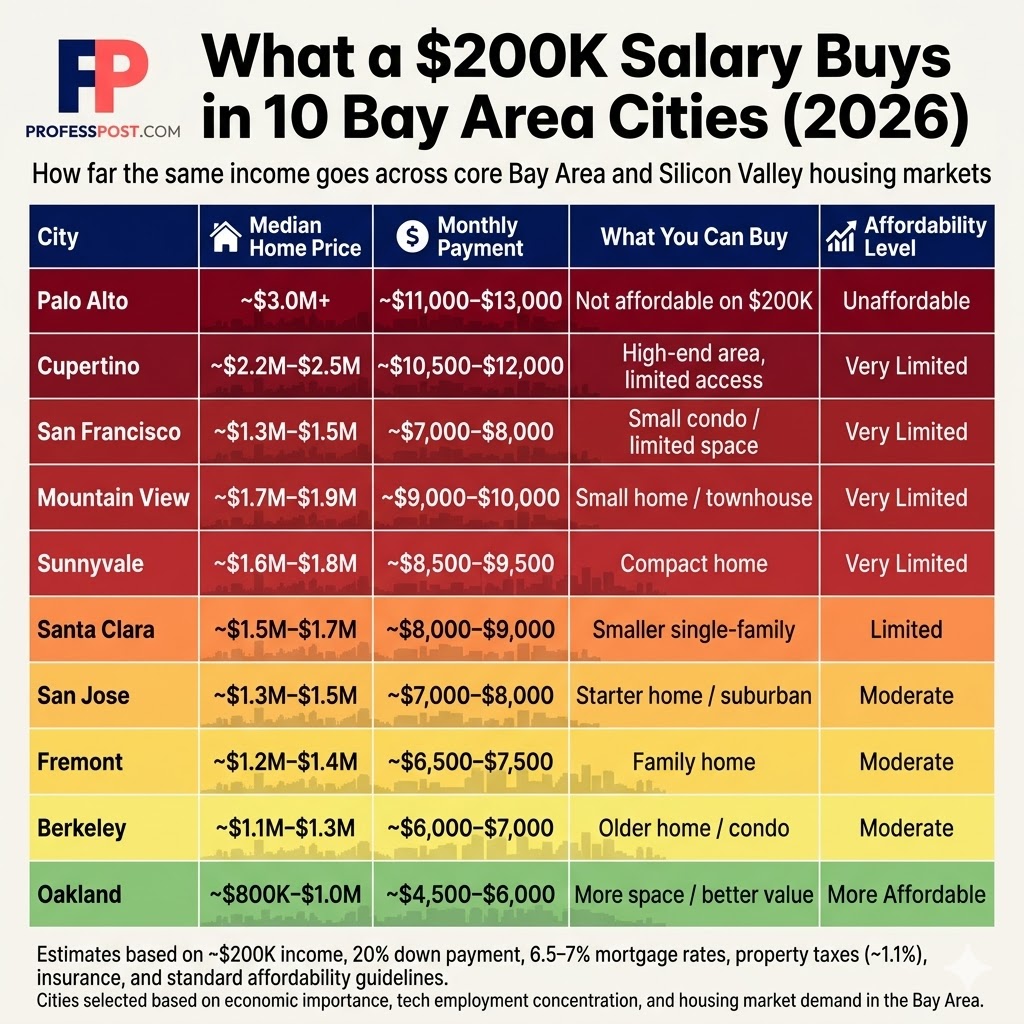
City-by-City Breakdown: What $200K Buys
San Francisco
Median Home: ~$1.3M–$1.5M
Reality: Condo or small unit
Verdict: High income, but financially tight
Palo Alto
Median Home: ~$3M+
Reality: Not realistically affordable
Verdict: $200K falls short for ownership
Mountain View
Median Home: ~$1.7M–$1.9M
Reality: Townhome or small house
Verdict: Very limited flexibility
Sunnyvale
Median Home: ~$1.6M–$1.8M
Reality: Compact single-family home
Verdict: Tight budget
Santa Clara
Median Home: ~$1.5M–$1.7M
Reality: Smaller home options
Verdict: Limited affordability
Cupertino
Median Home: ~$2M+
Reality: Highly competitive market
Verdict: Not practical for most buyers
San Jose
Median Home: ~$1.3M–$1.5M
Reality: Entry-level suburban home
Verdict: More balanced, still expensive
Fremont
Median Home: ~$1.2M–$1.4M
Reality: Family-friendly housing
Verdict: One of the better options
Berkeley
Median Home: ~$1.1M–$1.3M
Reality: Older homes or condos
Verdict: Moderate affordability
Oakland
Median Home: ~$800K–$1.0M
Reality: More space, better value
Verdict: Most affordable in this group
Where $200K Goes the Furthest (and the Least)
Best Value Cities
- Oakland
- Fremont
- San Jose
Most Challenging Cities
- Palo Alto
- Cupertino
- San Francisco
In practice, this means the same salary can provide a comfortable lifestyle in one city — and feel restrictive just a few miles away.
Why the Gap Is So Extreme
The Bay Area’s affordability gap is driven by several structural factors:
- Strong tech salaries competing for limited housing supply
- Zoning restrictions limiting new construction
- Investor activity increasing competition
- Persistent demand despite high interest rates
Even as price growth moderates, affordability remains one of the biggest barriers for buyers in 2026.
Related Analysis
If you want to compare how $200K performs nationally or dive deeper into specific cities, explore these breakdowns:
- What a $200K Salary Buys in 5 Major U.S. Cities
- San Diego Income Needed by Neighborhood
- San Francisco Home Affordability by Neighborhood
- San Francisco Rent-to-Income Ratios
Methodology
This analysis is based on a combination of publicly available housing market data, affordability models, and regional pricing trends.
- Home price estimates sourced from platforms such as Zillow and Redfin
- Mortgage assumptions based on 6.5%–7% interest rates
- Down payment assumption: 20%
- Property tax estimate: ~1.1% annually
- Includes insurance and typical ownership costs
- Affordability benchmark: 28–30% of gross income
All figures are rounded estimates intended to reflect real-world buying conditions in early 2026.
Sources
- Zillow – San Francisco Housing Data
- Redfin – Palo Alto Market Trends
- Bay Area Housing Forecast
- Bay Area Market Overview
Final Takeaway
In the Bay Area, your salary matters — but your ZIP code matters more.
A $200K income still places you among top earners nationally. But in this region, it often buys access to the market — not financial freedom within it.