Where a $150K Salary Still Feels “Rich” in America (2026 Reality Check)

Where a $150K Salary Still Feels “Rich” in America (2026 Reality Check)
In 2026, a $150,000 salary doesn’t mean the same thing everywhere. In some U.S. cities, it still delivers a comfortable, even affluent lifestyle. In others, it barely keeps up with rising housing costs and everyday expenses.
This growing divide isn’t just perception — it’s driven by real differences in rent, taxes, and cost of living. As housing continues to dominate household budgets, where you live now matters more than how much you earn.
If you’ve read our previous breakdowns like
what a $200K salary really buys or
how $250K performs in top ZIP codes, this analysis takes a more grounded approach — focusing on a highly relatable income level: $150K.
The Reality of a $150K Salary in 2026
At a national level, $150K still places a household well above the average U.S. income. However, that headline number can be misleading. Once taxes, rent, and basic expenses are factored in, the real purchasing power varies dramatically.
According to cost-of-living data, housing remains the single biggest driver of financial pressure in major cities, often consuming 40% to 60% of income in high-cost areas.
This explains why the same salary can feel “rich” in one city and restrictive in another.
Where $150K Still Feels Comfortable (or Even Rich)
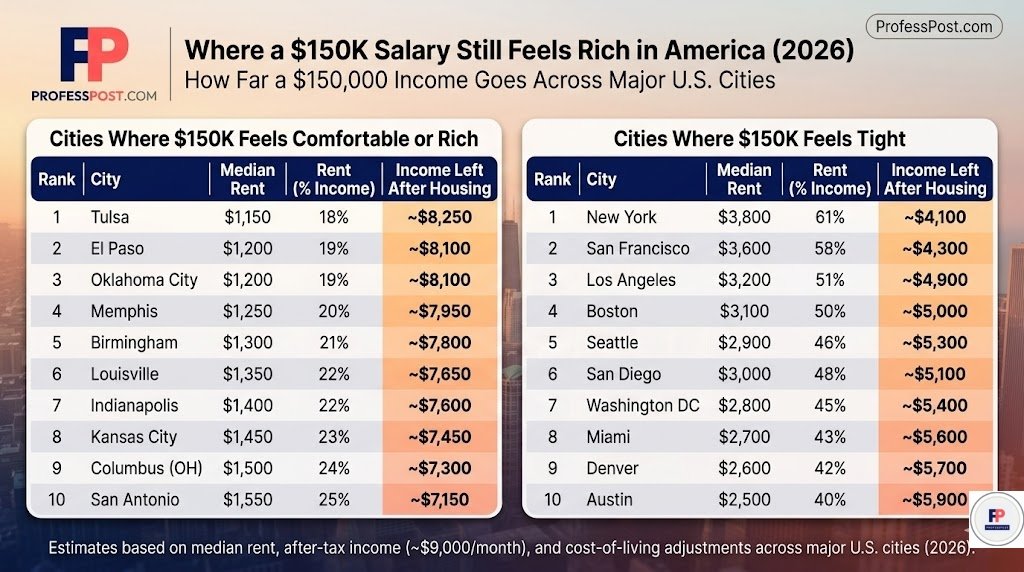
In lower-cost metro areas — especially across the Midwest and parts of the South — housing remains relatively affordable compared to income levels.
- Oklahoma City
- Tulsa
- Memphis
- Birmingham
- Louisville
- Indianapolis
- Kansas City
- Columbus (OH)
- San Antonio
- El Paso
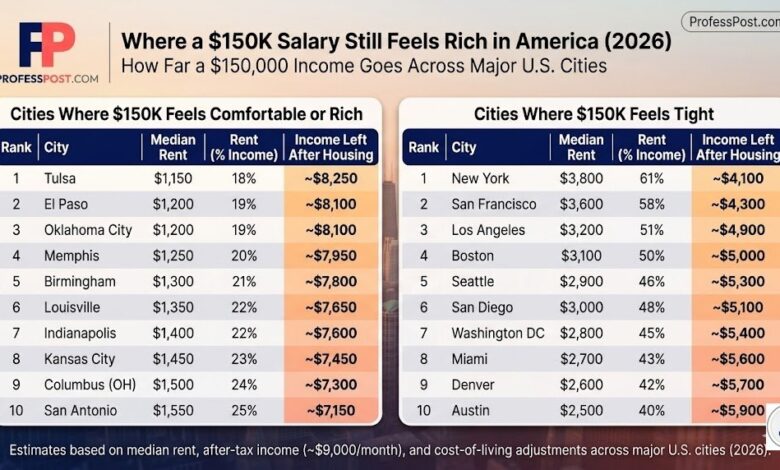
In these cities, rent typically stays below 25% of income for a $150K earner. That leaves substantial room for savings, investing, or lifestyle upgrades — which is why many households in these areas still feel financially ahead.
This aligns with broader findings that salaries stretch significantly further in lower-cost regions, even when nominal income is lower.
Where $150K Feels Average — Not Wealthy
In mid-tier cities, the picture becomes more balanced. Housing costs are higher, but not extreme enough to fully erase financial flexibility.
- Dallas
- Phoenix
- Atlanta
- Tampa
- Denver
Here, $150K provides a stable, comfortable lifestyle — but without the same margin for aggressive savings or luxury spending.
This is where many Americans now fall: financially secure, but not necessarily “rich.”
Where $150K Feels Tight
In high-cost coastal cities, the equation flips completely.
- New York
- San Francisco
- Los Angeles
- Boston
- Seattle
In these markets, housing alone can consume nearly half — or more — of after-tax income. Once utilities, transportation, and daily expenses are added, disposable income shrinks quickly.
This is part of a broader trend where income growth is no longer keeping pace with living costs, leading many workers to feel financially constrained despite high salaries.
Why Location Matters More Than Income
One of the biggest misconceptions is that higher salaries automatically translate into better living standards. In reality, cost of living and wages are driven by different forces.
Economic research shows that salaries reflect local labor markets, while cost of living is shaped by housing demand, goods, and services — meaning they don’t always align.
This disconnect is exactly why $150K can feel like financial freedom in one city and financial pressure in another.
The Bigger Trend: Income Compression
Across the U.S., the gap between “middle class” and “high income” is narrowing in expensive cities. A salary that once guaranteed a high standard of living now delivers only moderate comfort in places like New York or San Francisco.
If you want a deeper look at how salaries translate into real-life purchasing power, check out our full breakdown:
what your salary actually feels like by city.
Final Thoughts
A $150K salary still has strong earning power in America — but only in the right locations.
In lower-cost cities, it can provide a genuinely affluent lifestyle. In high-cost metros, it often lands squarely in the middle class.
The takeaway is simple: income matters, but geography matters more.
For a more detailed comparison of solo living costs, you can also explore our guide on
how much you need to live alone in U.S. cities.
Methodology
This analysis is based on estimated 2026 data across major U.S. cities, combining multiple cost components to evaluate how far a $150K salary actually goes.
- Median rent data (1-bedroom and city averages)
- Estimated after-tax income (~$9,000/month for $150K salary)
- Cost-of-living indices (housing, groceries, utilities, transportation)
- Affordability benchmarks (30% rent-to-income guideline)
We categorized cities into three groups based on:
- Housing burden (% of income spent on rent)
- Remaining disposable income
- Overall cost pressure
The goal is not to define “rich” universally, but to measure how far income stretches in practical, everyday terms.
Sources
- Numbeo Cost of Living Index (2026)
- U.S. Bureau of Labor Statistics (BLS)
- Housing market estimates and rent data (2026 projections)
- Expatica cost of living data
- Economic Research Institute (ERI) insights on cost vs wages