A $150,000 salary sounds very different on a paycheck than it does on a job offer.
For a single worker in 2026, federal income taxes, Social Security and Medicare can take a significant portion of that salary before money reaches your bank account. And where you live can make another meaningful difference because state and local taxes vary widely.
Here’s what a $150,000 salary actually looks like.
A $150K Salary Starts at $12,500 a Month
A $150,000 annual salary equals:
- $150,000 gross income
- $12,500 per month
- $2,884.62 per week
But gross income isn’t what you take home.
For 2026, the federal standard deduction for a single taxpayer is $16,100. Federal income-tax rates range from 10% to 37%, with different portions of taxable income taxed at different rates. Importantly, moving into a higher tax bracket does not mean your entire salary is taxed at that higher rate.
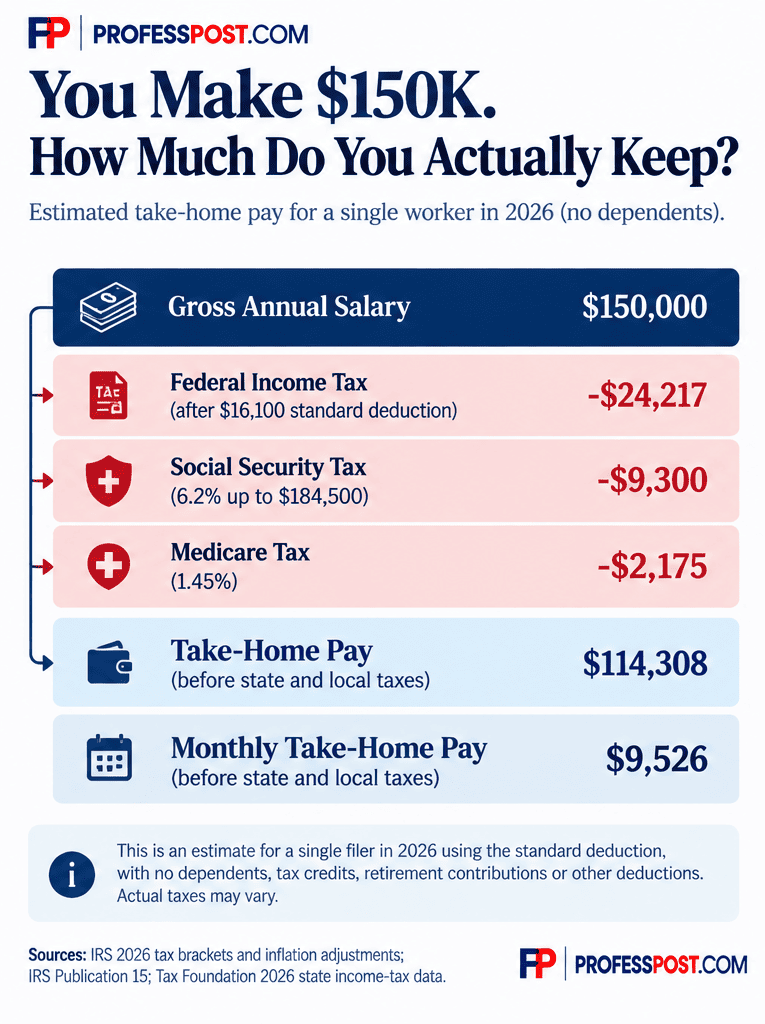
Assuming a single filer taking the standard deduction, with no major tax credits or additional deductions, $150,000 of gross income produces approximately $133,900 of federal taxable income.
That results in roughly $24,217 in federal income tax under the 2026 brackets.
Then Come Social Security and Medicare
Federal income tax isn’t the only deduction. Employees also pay 6.2% for Social Security and 1.45% for Medicare. In 2026, Social Security applies only to wages up to $184,500, so the entire $150,000 salary is subject to the 6.2% tax. Medicare has no wage ceiling.
For a $150,000 salary:
- Social Security: $9,300
- Medicare: $2,175
- Federal income tax: ≈ $24,217
That’s approximately $35,692 in federal taxes and payroll taxes.
That leaves about $114,308. Or roughly: $9,526 per month before state and local income taxes. And this is where location starts to matter.
$150K Doesn’t Mean the Same Thing Everywhere
Some states have no individual state income tax, including Florida and Texas. Alaska, Nevada, South Dakota, Tennessee and Wyoming also do not impose a broad individual income tax.
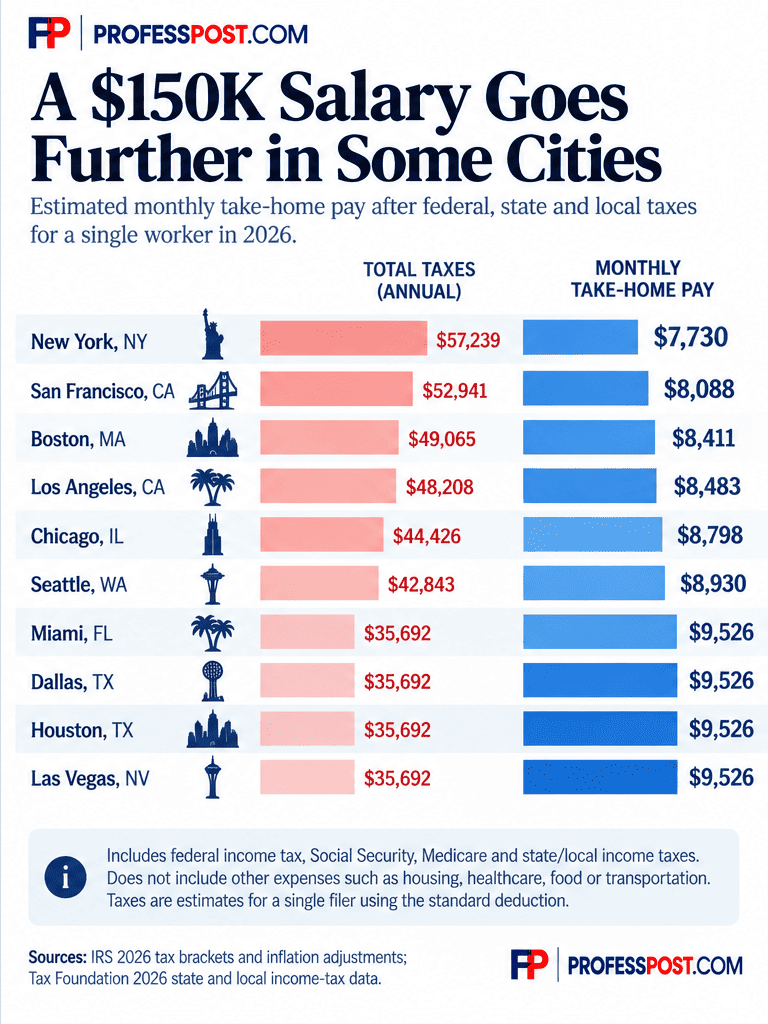
For someone earning $150,000, that can mean keeping substantially more of their paycheck than someone earning the same salary in a state with a significant income tax.
California, for example, uses a graduated individual income-tax system with rates reaching 13.3% at the highest income levels, while New York also uses graduated rates. These top rates don’t apply to a $150,000 salary in their entirety, but the state tax still reduces take-home pay.
And state income tax isn’t the entire story. Depending on where you live, your household budget can also be affected by:
- Property taxes
- Local income taxes
- Housing costs
- Health insurance
- Car insurance
- Childcare
- Transportation
That’s why two people earning exactly $150,000 can have very different amounts left at the end of the year.
The Bigger Point
A $150,000 salary is $12,500 per month before taxes, but a single filer under the assumptions above has roughly $9,526 per month after federal income tax, Social Security and Medicare—and that’s before state or local taxes and before spending on housing, food, transportation, healthcare or other expenses.
So when someone says, “I make $150K,” there’s an important question behind the number:
How much of that $150K actually stays with you?
That’s the number that matters when comparing jobs, cities and lifestyles.
Note: This is an illustrative 2026 calculation for a single employee using the standard deduction, with no dependents, tax credits, retirement contributions, itemized deductions or other special circumstances. Actual take-home pay can differ substantially depending on filing status, benefits, deductions, state and local taxes.
Sources: IRS 2026 tax brackets and inflation adjustments; IRS Publication 15; Tax Foundation’s 2026 state individual income-tax tables.