The U.S. Cities With the Highest and Lowest Car Ownership Rates in 2026


The U.S. Cities With the Highest and Lowest Car Ownership Rates in 2026
Car ownership remains one of the clearest indicators of how Americans live, commute, and spend money. In some cities, owning multiple vehicles is practically required for daily life. In others, millions of residents live comfortably without ever needing a car.
Using estimated transportation and household vehicle trends based on recent U.S. Census American Community Survey (ACS) data, we compared car ownership patterns across America’s 50 largest cities to see where vehicle dependency remains highest — and where transit-oriented living still dominates.
America’s Car Ownership Divide
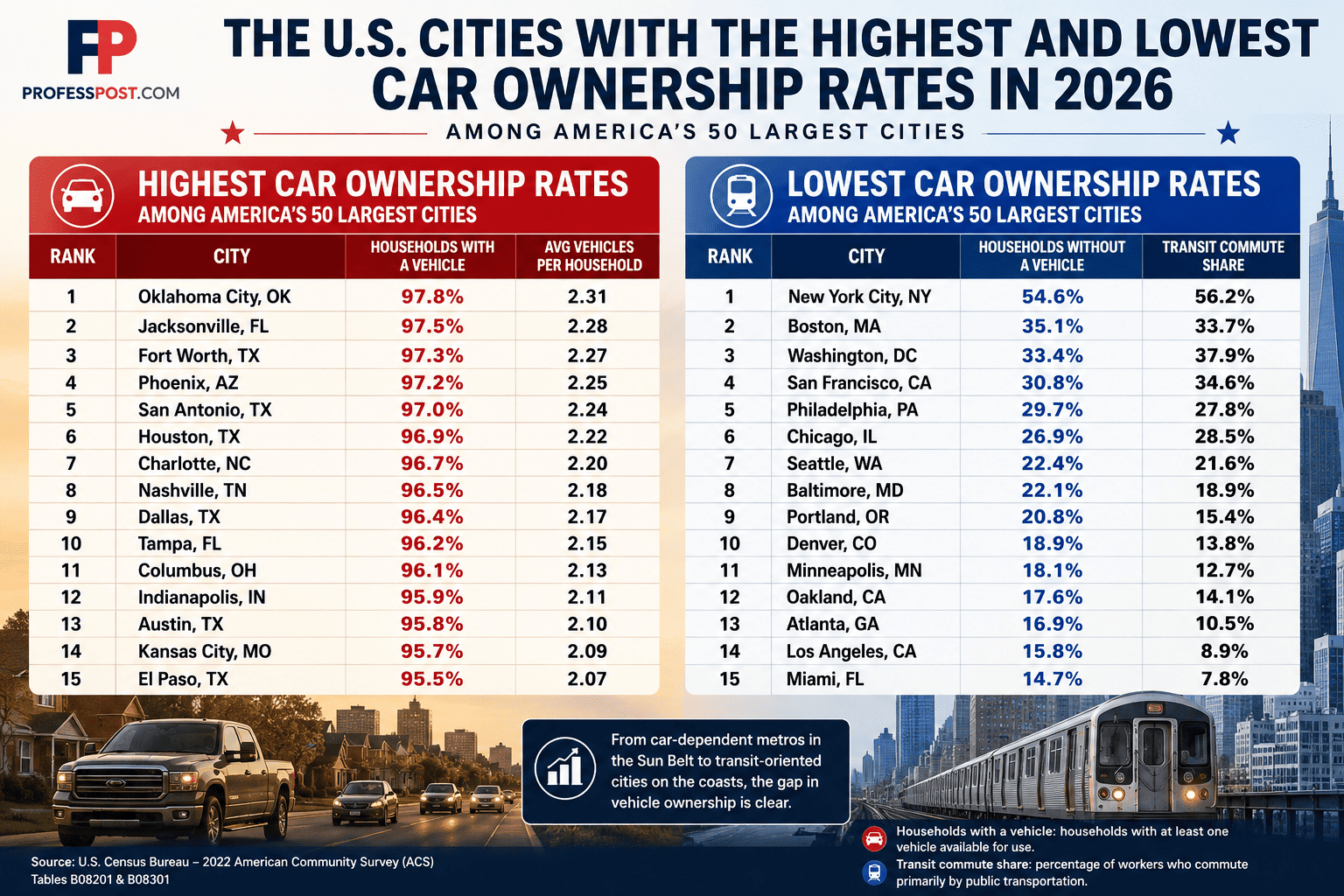
The results reveal a major divide between sprawling Sun Belt metros and dense coastal cities with stronger public transportation systems.
In cities like Oklahoma City, Jacksonville, Phoenix, and Houston, car ownership rates remain extremely high. Many households own two or more vehicles, reflecting suburban development patterns, long commute distances, and limited transit infrastructure.
Meanwhile, cities like New York, Boston, Washington DC, and San Francisco continue to support large car-free populations thanks to density, walkability, and public transportation access.
Cities With the Highest Car Ownership Rates
Among America’s largest cities, Oklahoma City ranked highest in estimated household vehicle ownership, with nearly 98% of households owning at least one vehicle.
Texas cities dominated the rankings overall, with Fort Worth, San Antonio, Houston, Dallas, and El Paso all appearing near the top. Florida cities also ranked highly, particularly Jacksonville and Tampa.
Top Estimated Car Ownership Leaders
- Oklahoma City, OK: 97.8%
- Jacksonville, FL: 97.5%
- Fort Worth, TX: 97.3%
- Phoenix, AZ: 97.2%
- San Antonio, TX: 97.0%
Many of these metros also average more than two vehicles per household — a sign of how deeply car dependency is built into local infrastructure and suburban lifestyles.
Cities With the Lowest Car Ownership Rates
On the opposite end, New York City remains America’s least car-dependent major city by a wide margin.
More than half of NYC households are estimated to live without a vehicle, supported by the country’s largest public transportation network.
Boston, Washington DC, San Francisco, and Philadelphia also continue to maintain large transit-oriented populations.
Lowest Estimated Vehicle Ownership Cities
- New York City, NY: 54.6% of households without a vehicle
- Boston, MA: 35.1%
- Washington, DC: 33.4%
- San Francisco, CA: 30.8%
- Philadelphia, PA: 29.7%
These cities also rank among America’s strongest transit markets, with large portions of workers commuting by subway, rail, bus, or other forms of public transportation.
Why Car Ownership Still Matters
Vehicle ownership is closely tied to cost of living, infrastructure, and housing patterns.
In highly car-dependent cities, households often face higher transportation costs through fuel, insurance, maintenance, parking, and financing expenses. At the same time, these markets may offer larger homes and more suburban development.
Meanwhile, transit-oriented cities often trade lower car ownership for higher housing density and elevated real estate costs.
That affordability tradeoff mirrors broader economic shifts happening across the country. Our analysis of rising home prices versus income growth highlights how transportation and housing costs increasingly shape where Americans can realistically afford to live.
The Cost of “Feeling Rich” in Modern America
Transportation expenses also influence how far salaries stretch in different cities.
In some metros, a six-figure income can still provide a relatively comfortable suburban lifestyle. In others, even higher earners face significant affordability pressure.
For more comparisons, see our breakdown of where a $150K salary still feels rich in America and our analysis of what it takes to be considered rich across America’s largest cities.
Final Takeaway
America’s transportation habits remain deeply divided between car-dependent metros and transit-oriented urban centers.
In much of the Sun Belt, vehicle ownership is still essentially mandatory for daily life. But in dense coastal cities, millions of residents continue proving that living without a car is not only possible — but increasingly common.
As housing affordability, urban density, and transportation infrastructure continue evolving, that divide may become even more pronounced over the next decade.
Disclaimer: Figures shown are estimated using recent U.S. Census ACS transportation and household vehicle trends. Values are intended for editorial and informational purposes.