Best U.S. Metro Areas to Build Wealth From Scratch (2026)
Building wealth from scratch is a very different challenge than preserving wealth you already have.
If you already own a home, have family support, or built equity years ago, expensive metros like New York or Los Angeles may still make financial sense. But for households starting with little or no assets, the question becomes much more practical:
Where can you realistically build wealth fastest?
To answer that, we ranked major U.S. metro areas based on a Wealth Building Opportunity Score, designed to reflect the real-world conditions that matter most for people starting from zero.
Rather than focusing only on salary, this ranking considers whether households can actually keep enough income after taxes and living costs to save, invest, and eventually buy a home.
Top 10 U.S. Metro Areas to Build Wealth From Scratch
According to our ranking, these metros offer the strongest wealth-building conditions in 2026:
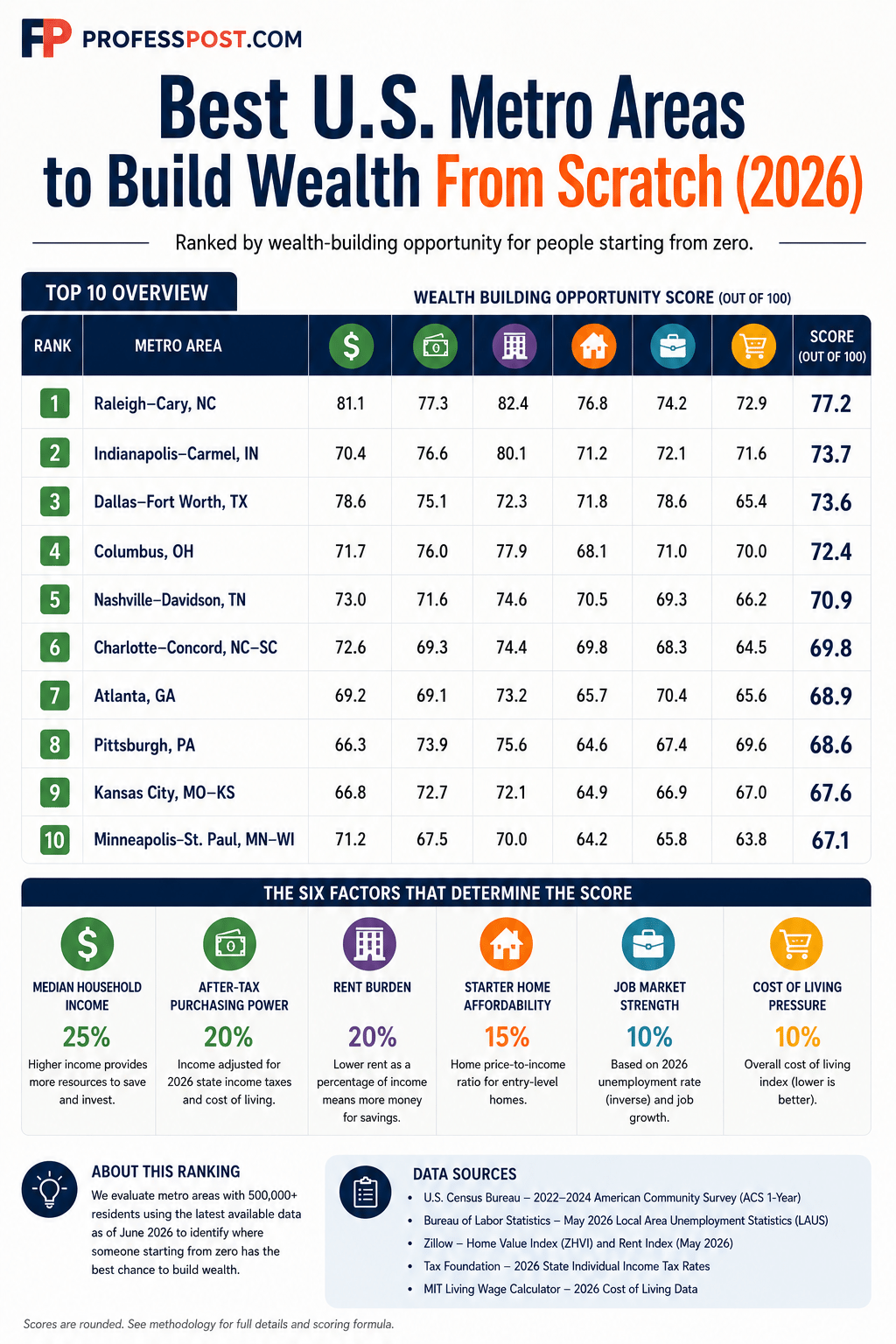
- Raleigh-Cary, NC
- Indianapolis-Carmel, IN
- Dallas-Fort Worth, TX
- Columbus, OH
- Nashville-Davidson, TN
- Charlotte-Concord, NC-SC
- Atlanta, GA
- Pittsburgh, PA
- Kansas City, MO-KS
- Minneapolis-St. Paul, MN-WI
Why Raleigh Ranked #1
Raleigh takes the top spot because it checks nearly every important box.
The region combines strong income potential, relatively favorable taxes, manageable rent compared to many coastal metros, and a healthier path to homeownership than America’s most expensive housing markets.
That combination matters.
A six-figure salary in an ultra-expensive city can look impressive on paper, but if housing and taxes consume most of that income, wealth building becomes far harder.
Raleigh’s balance makes it especially attractive for households trying to build assets from scratch.
Why Indianapolis Was a Surprise #2
Indianapolis may surprise readers who expect only Sun Belt cities to dominate this kind of ranking.
But affordability still matters enormously.
Indianapolis performs well because households can keep more of what they earn. Housing remains significantly more accessible than many major metros, and cost-of-living pressure is far lower than expensive coastal regions.
Wealth building is not just about earning more—it’s about keeping enough to invest consistently.
Texas Still Shows Up—But Doesn’t Dominate
Many readers may expect Texas to completely dominate a wealth-building ranking.
Dallas-Fort Worth earns a strong #3 ranking thanks to high income opportunity, no state income tax, and continued job growth.
But Texas does not completely take over the list.
Why?
Because no state income tax does not automatically equal easy wealth building.
Property taxes, rising housing prices, insurance costs, and increased living expenses reduce some of Texas’ traditional affordability advantage.
That’s why Dallas ranks highly, but not automatically #1.
The Midwest’s Quiet Strength
One of the biggest takeaways from this ranking is how well Midwestern metros perform.
Cities like:
- Indianapolis
- Columbus
- Kansas City
- Pittsburgh
- Minneapolis
all benefit from something increasingly rare in America:
reasonable affordability paired with stable economic opportunity.
That’s a powerful combination for long-term wealth creation.
A household that can consistently save and invest over 10–15 years often ends up in a stronger position than one earning more but constantly fighting high living costs.
Why Some Famous Cities Don’t Make the Top 10
This ranking is not about prestige. It’s about financial efficiency. That’s why some of America’s most famous metros rank lower.
New York
New York offers incredible career opportunity, but households starting from zero face enormous housing costs, heavy taxes, and some of the highest day-to-day living expenses in the country.
That makes wealth accumulation much harder.
Los Angeles
Los Angeles has strong income potential, but housing affordability remains one of its biggest obstacles.
For newcomers without existing assets, the barrier to entry is steep.
San Francisco
The Bay Area can generate exceptional income.
But for people starting with zero, extremely high housing costs dramatically reduce the speed of wealth accumulation.
How We Ranked the Cities
Our Wealth Building Opportunity Score (out of 100) uses six weighted factors:
1. Median Household Income (25%)
Higher incomes increase wealth-building potential, but only if households can retain enough of that income after major expenses.
2. After-Tax Purchasing Power (20%)
Gross salary can be misleading.
This factor considers how much income remains after federal, payroll, and state tax obligations.
3. Rent Burden (20%)
Rent is one of the biggest barriers to saving.
A metro where rent consumes a smaller share of household income gives residents more room to build wealth.
4. Starter Home Affordability (15%)
Homeownership remains one of the most important wealth-building tools for many Americans.
We considered whether entry-level home prices are realistically accessible relative to local incomes.
5. Job Market Strength (10%)
Strong employment conditions improve financial resilience.
This includes hiring conditions and metro-level unemployment performance.
6. Cost-of-Living Pressure (10%)
Groceries, transportation, utilities, and insurance all affect how much households can actually save.
Data Sources
This ranking uses the latest broadly available data as of 2026, including:
- U.S. Census Bureau American Community Survey (ACS) for household income metrics
- Bureau of Labor Statistics (BLS) for employment and unemployment data
- Zillow housing market data for home value and rent trends
- Tax Foundation for 2026 state tax frameworks
- MIT Living Wage / cost-of-living reference data
Because official datasets update on different timelines, this analysis reflects the most recent available indicators rather than a single identical reporting year.
Final Take
If you’re building wealth from scratch, the best metro is not necessarily the one with the highest salary.
It’s the one where income, affordability, and opportunity still work together.
That increasingly points toward balanced metros like Raleigh, Indianapolis, Columbus, Dallas, and Charlotte—not just America’s most expensive superstar cities.
For first-generation wealth builders, financial flexibility may matter more than prestige.