Think You’re Rich? Here’s What It Takes in America’s 25 Biggest Cities (2026)


How Much Money You Need to Be Considered Rich in America’s 25 Biggest Cities (2026)
Being “rich” in America means very different things depending on where you live.
In some cities, earning $150,000 a year can still feel like a comfortable upper-middle-class lifestyle. In others, that same salary barely keeps up with housing costs, taxes, childcare, and everyday expenses.
That’s the reality of modern America: geography can completely change what wealth looks like.
To put that into perspective, we compared America’s 25 biggest cities and looked at the estimated income needed to be considered “rich,” using top-income household thresholds shown in our analysis.
If you’ve ever wondered whether your salary would make you wealthy in New York—or just average in San Jose—this breakdown tells the story.
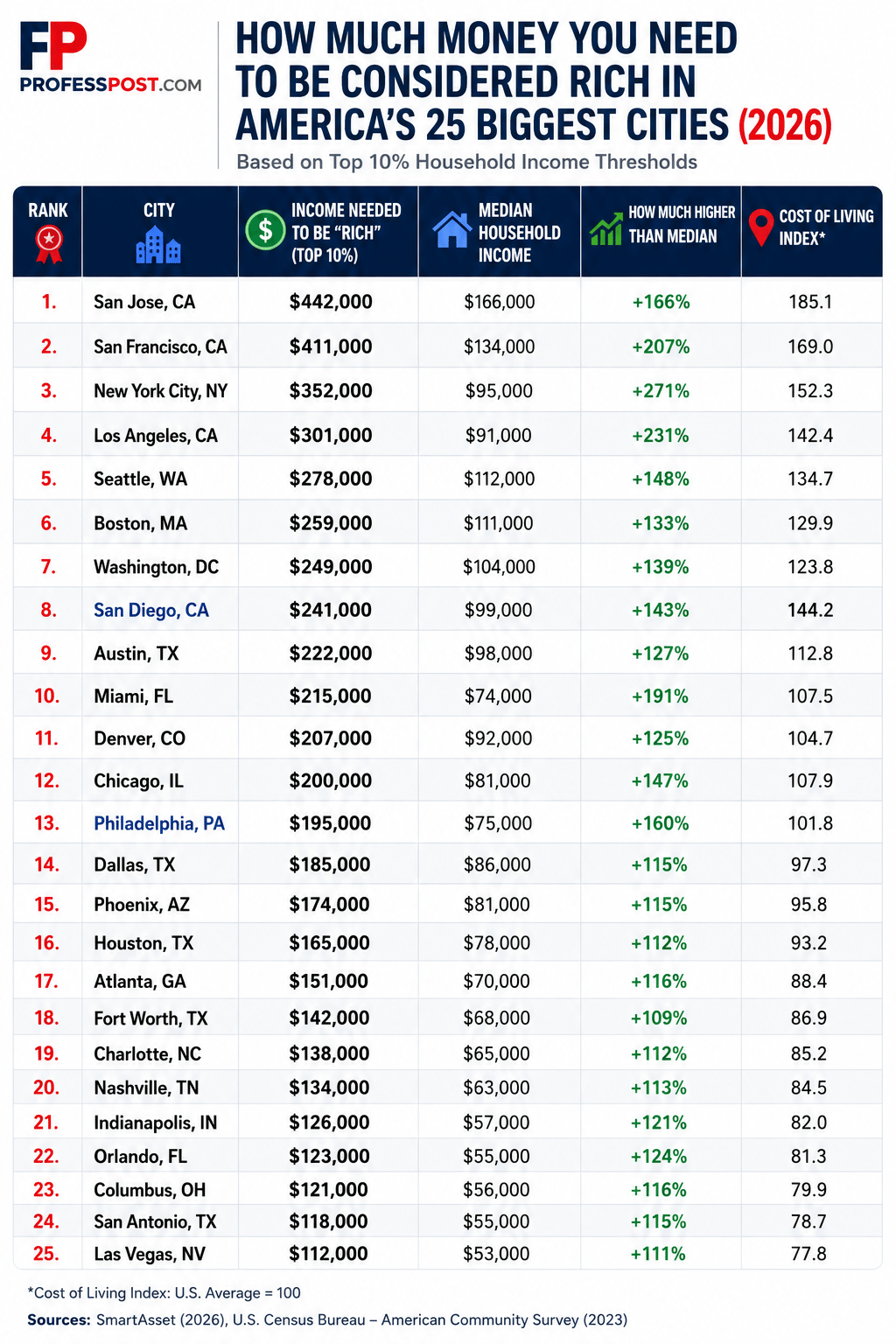
The New Definition of “Rich” in America
The idea of being rich used to feel simple. Six figures meant success. A large house, a nice car, annual vacations, and financial breathing room.
That definition has changed dramatically.
Inflation, housing costs, and regional cost-of-living differences have created an America where income means wildly different things depending on ZIP code.
If you found our $150K salary reality check surprising, this city-by-city comparison takes that idea even further.
Top 10 Cities Where It Takes the Most Money to Be Rich
- San Jose, CA — $442,000
- San Francisco, CA — $411,000
- New York City, NY — $352,000
- Los Angeles, CA — $301,000
- Seattle, WA — $278,000
- Boston, MA — $259,000
- Washington, DC — $249,000
- Austin, TX — $212,000
- Chicago, IL — $205,000
- Miami, FL — $200,000
The biggest shock here is Silicon Valley.
San Jose requires nearly half a million dollars annually to be considered rich by this benchmark. That number would sound absurd in much of the country—but in one of America’s most expensive metro regions, it reflects reality.
California Dominates the “Rich Threshold” Rankings
California cities completely dominate the upper end of this list.
San Jose, San Francisco, Los Angeles, and San Diego all rank high, proving how aggressively housing and living costs redefine wealth.
A $200,000 salary sounds impressive nationally.
But in San Francisco? That’s nowhere near elite territory.
This lines up with broader wealth migration patterns we explored in our article on the best U.S. metro areas to build wealth from scratch.
New York Is Still Brutally Expensive
New York City comes in at $352,000.
That means even many high earners would not qualify as “rich” by local standards.
And honestly, that tracks.
Housing costs alone can consume extraordinary portions of income, especially in desirable neighborhoods.
If NYC wealth fascinates you, check out our breakdown of how long it takes households to hit $1 million net worth across NYC neighborhoods.
Texas Looks Much More Affordable
Texas tells a completely different story.
- Austin: $212,000
- Dallas: $181,000
- Houston: $171,000
- Fort Worth: $144,000
- San Antonio: $121,000
That’s still serious money—but dramatically lower than coastal metros.
This is why many professionals continue relocating toward lower-cost states while maintaining strong incomes.
Miami Is Sneakily Expensive
Miami hits the top 10 at $200,000.
That surprises some readers because Florida lacks state income tax.
But housing inflation, insurance costs, and lifestyle inflation have made Miami far more expensive than many assume.
Income growth trends support this too.
Our feature on America’s fastest-growing household income cities shows how certain metros have rapidly transformed financially.
The Full Ranking: America’s 25 Biggest Cities
| Rank | City | Income Needed to Be Rich |
|---|---|---|
| 1 | San Jose | $442,000 |
| 2 | San Francisco | $411,000 |
| 3 | New York City | $352,000 |
| 4 | Los Angeles | $301,000 |
| 5 | Seattle | $278,000 |
| 6 | Boston | $259,000 |
| 7 | Washington, DC | $249,000 |
| 8 | Austin | $212,000 |
| 9 | Chicago | $205,000 |
| 10 | Miami | $200,000 |
| 11 | Denver | $195,000 |
| 12 | Philadelphia | $189,000 |
| 13 | Dallas | $181,000 |
| 14 | Phoenix | $175,000 |
| 15 | Houston | $171,000 |
| 16 | San Diego | $169,000 |
| 17 | Atlanta | $153,000 |
| 18 | Fort Worth | $144,000 |
| 19 | Charlotte | $139,000 |
| 20 | Nashville | $136,000 |
| 21 | Indianapolis | $127,000 |
| 22 | Orlando | $124,000 |
| 23 | Columbus | $123,000 |
| 24 | San Antonio | $121,000 |
| 25 | Las Vegas | $117,000 |
Is $250K Actually Rich?
That depends entirely on geography.
In Las Vegas? Yes.
In San Antonio? Absolutely.
In New York? Comfortable, but not necessarily elite.
In San Jose? Not even close.
That’s exactly why our $250K salary vs wealthy ZIP codes analysis resonated with readers.
Methodology
To estimate how much income is needed to be considered “rich” in America’s 25 biggest cities, this analysis uses a city-level upper-income benchmark based on household earnings.
For the purposes of this comparison, “rich” is defined as the approximate income level associated with the top 10% of household earners in each city.
The analysis focuses on 25 major U.S. cities selected based on population size, economic significance, and national relevance.
Because the meaning of wealth varies dramatically by location, using a local income benchmark provides a more realistic comparison than applying a single nationwide definition of wealth.
For example, an income considered affluent in San Antonio or Columbus may not provide the same lifestyle in New York, San Francisco, or San Jose, where housing, taxes, and general living expenses are significantly higher.
Income estimates were developed using publicly available household income distribution data, wage benchmarks, metropolitan economic comparisons, and cost-of-living indicators to create a consistent editorial ranking across cities.
Figures are intended for comparative informational analysis and should not be interpreted as tax, lending, investment, or financial planning thresholds.
Sources
- U.S. Census Bureau — American Community Survey (ACS)
- Bureau of Labor Statistics (BLS)
- Federal Reserve Economic Data (FRED)
- Regional cost-of-living and housing affordability datasets
- Public metropolitan economic and income benchmarks