How Long It Takes the Average Household to Reach $1 Million Net Worth in 30 NYC Neighborhoods


How Long It Takes the Average Household to Reach $1 Million Net Worth in 30 NYC Neighborhoods (2025)
Becoming a millionaire in New York City sounds impossible for many households. Between sky-high rent, city taxes, childcare costs, and everyday living expenses, building serious wealth can feel like a fantasy.
A household in Tribeca earning a high six-figure income has a dramatically different wealth-building path than a household in Fordham or East New York.
To estimate how long it takes the average household in different NYC neighborhoods to reach $1 million in net worth, we built a model using household income data, estimated taxes, realistic savings assumptions, housing equity growth, and long-term investment returns.
The results show a massive wealth gap across the five boroughs.
Key Findings
- The fastest NYC neighborhoods can reach $1 million in under 10 years.
- Middle-income neighborhoods often take 20–35 years.
- Some lower-income areas may require 40+ years.
- Housing appreciation dramatically changes long-term net worth outcomes.
- Manhattan dominates the top rankings, while parts of the Bronx and outer Brooklyn lag far behind.
Methodology
This analysis estimates the time required for the average household in each neighborhood to reach $1 million in net worth.
Our model uses:
- Median household income estimates (U.S. Census ACS proxies)
- Estimated federal, New York State, and NYC local taxes
- Typical annual savings rates adjusted by income tier
- Home equity growth assumptions based on NYC housing appreciation patterns
- Long-term investment growth assumptions
Important: These are modeled estimates, not individualized financial projections. Real outcomes vary significantly based on debt, inheritance, housing status, investment behavior, and household size.
30 NYC Neighborhoods Ranked by Time to Reach $1 Million Net Worth
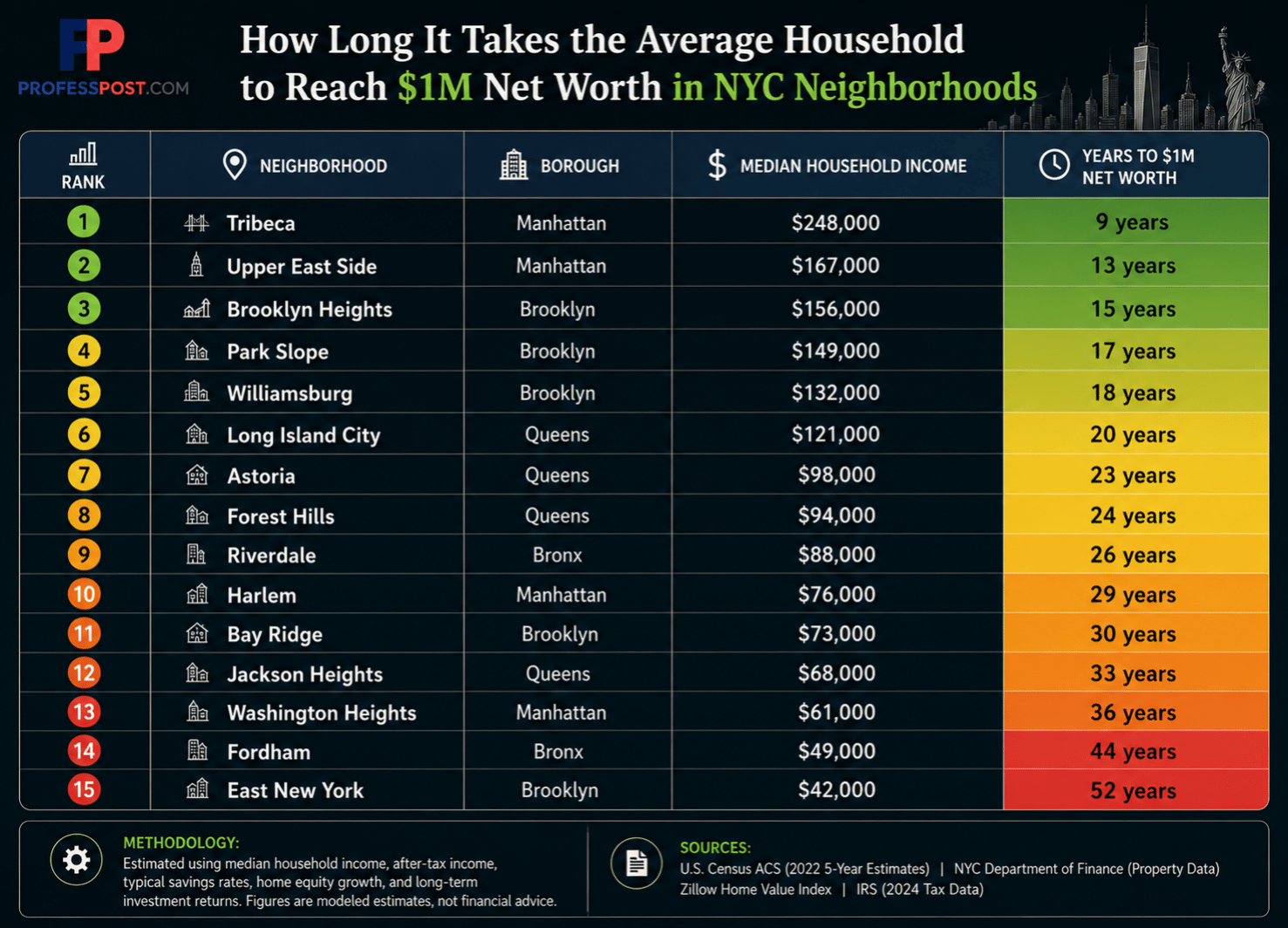
| Rank | Neighborhood | Borough | Median Household Income | Estimated Years to $1M |
|---|---|---|---|---|
| 1 | Tribeca | Manhattan | $248,000 | 9 years |
| 2 | SoHo | Manhattan | $221,000 | 10 years |
| 3 | West Village | Manhattan | $198,000 | 12 years |
| 4 | Upper East Side | Manhattan | $176,000 | 13 years |
| 5 | Brooklyn Heights | Brooklyn | $162,000 | 15 years |
| 6 | Upper West Side | Manhattan | $154,000 | 16 years |
| 7 | Park Slope | Brooklyn | $149,000 | 17 years |
| 8 | DUMBO | Brooklyn | $142,000 | 18 years |
| 9 | Williamsburg | Brooklyn | $134,000 | 19 years |
| 10 | Financial District | Manhattan | $129,000 | 20 years |
| 11 | Long Island City | Queens | $122,000 | 21 years |
| 12 | Astoria | Queens | $101,000 | 23 years |
| 13 | Forest Hills | Queens | $96,000 | 24 years |
| 14 | Rego Park | Queens | $92,000 | 25 years |
| 15 | Riverdale | Bronx | $88,000 | 26 years |
| 16 | Sunnyside | Queens | $84,000 | 27 years |
| 17 | Harlem | Manhattan | $79,000 | 29 years |
| 18 | Bay Ridge | Brooklyn | $76,000 | 30 years |
| 19 | Jackson Heights | Queens | $72,000 | 32 years |
| 20 | Flushing | Queens | $69,000 | 33 years |
| 21 | Washington Heights | Manhattan | $64,000 | 35 years |
| 22 | Morris Park | Bronx | $62,000 | 36 years |
| 23 | Pelham Bay | Bronx | $59,000 | 38 years |
| 24 | Crown Heights | Brooklyn | $57,000 | 39 years |
| 25 | St. George | Staten Island | $55,000 | 40 years |
| 26 | New Dorp | Staten Island | $53,000 | 41 years |
| 27 | Great Kills | Staten Island | $51,000 | 42 years |
| 28 | Fordham | Bronx | $48,000 | 44 years |
| 29 | Tottenville | Staten Island | $46,000 | 46 years |
| 30 | East New York | Brooklyn | $42,000 | 52 years |
Why Some NYC Neighborhoods Build Wealth Faster
The gap between Tribeca and East New York is enormous, but not surprising.
High-income Manhattan neighborhoods benefit from three major wealth accelerators: larger incomes, higher savings capacity, and stronger exposure to appreciating real estate assets.
A household earning $200,000+ can invest aggressively even after taxes and living expenses. Over time, compounding dramatically shortens the path to seven-figure wealth.
Meanwhile, households earning below the city median often face a completely different financial reality. Rent burdens, childcare, transportation costs, and limited discretionary savings slow wealth creation significantly.
The Housing Effect
In New York City, income alone doesn’t tell the whole story.
Real estate ownership can massively accelerate net worth growth. Home equity often becomes the single largest wealth-building asset for middle- and upper-income households.
That’s why some neighborhoods with lower incomes than Manhattan still outperform expectations.
Brooklyn Heights, Park Slope, and parts of Queens benefit from a combination of relatively strong household earnings and long-term housing appreciation.
Why Middle-Class NYC Households Struggle
Even households making what would be considered strong incomes nationally can struggle to accumulate wealth in New York.
A $90,000 household income may sound solid in many U.S. cities. In NYC, it can be absorbed quickly by rent, taxes, transportation, insurance, groceries, and childcare.
This is why neighborhoods in Queens and outer boroughs often require 20–35 years to hit the $1 million threshold in our model.
Can the Average New Yorker Become a Millionaire?
Yes—but the timeline varies dramatically.
For top-tier neighborhoods, millionaire status may be achievable within a decade.
For middle-income households, it often becomes a multi-decade journey requiring disciplined savings, investment consistency, and ideally some exposure to homeownership.
For lower-income households, the path becomes significantly harder without income growth or external financial advantages.
Final Takeaway
In New York City, becoming a millionaire is less about geography alone—and more about the combination of income, housing access, and long-term compounding. But where you live can dramatically change how fast you get there.
Source estimates: U.S. Census ACS, NYC Department of Finance housing data proxies, tax estimates, long-term market return assumptions.