If You Bought a Home in These Luxury ZIP Codes in 2016, Here’s What It Could Be Worth in 2026


If You Bought a Home in These Luxury ZIP Codes in 2016, Here’s What It Could Be Worth in 2026
Over the past decade, America’s luxury housing market has created staggering paper wealth for homeowners in some of the country’s most exclusive ZIP codes. From Silicon Valley enclaves to Palm Beach waterfront estates, high-end real estate appreciation has dramatically outpaced broader income growth in many affluent areas.
While many Americans have seen wages rise over the past 10 years, housing costs have climbed even faster in many markets. Our recent analysis of how home prices outpaced median household income growth shows just how dramatic the affordability shift has become.
This analysis looks at estimated luxury home value appreciation between 2016 and 2026 across some of America’s most elite ZIP codes, highlighting where homeowners gained the most in absolute dollars—and where appreciation moved fastest by percentage.
America’s Luxury Housing Boom by the Numbers
Luxury real estate has always rewarded long-term owners, but the past decade created unusually large gains thanks to low inventory, wealth migration, remote work flexibility, and strong asset inflation.
Some familiar names dominate the list.
- Atherton, California (94027) remained one of America’s premier wealth hubs, benefiting from continued tech wealth creation.
- Fisher Island, Florida (33109) saw major gains as wealthy buyers increasingly favored tax-friendly Florida markets.
- Tribeca, New York (10007) continued attracting high-income finance and executive buyers despite broader urban market shifts.
Biggest Dollar Gains
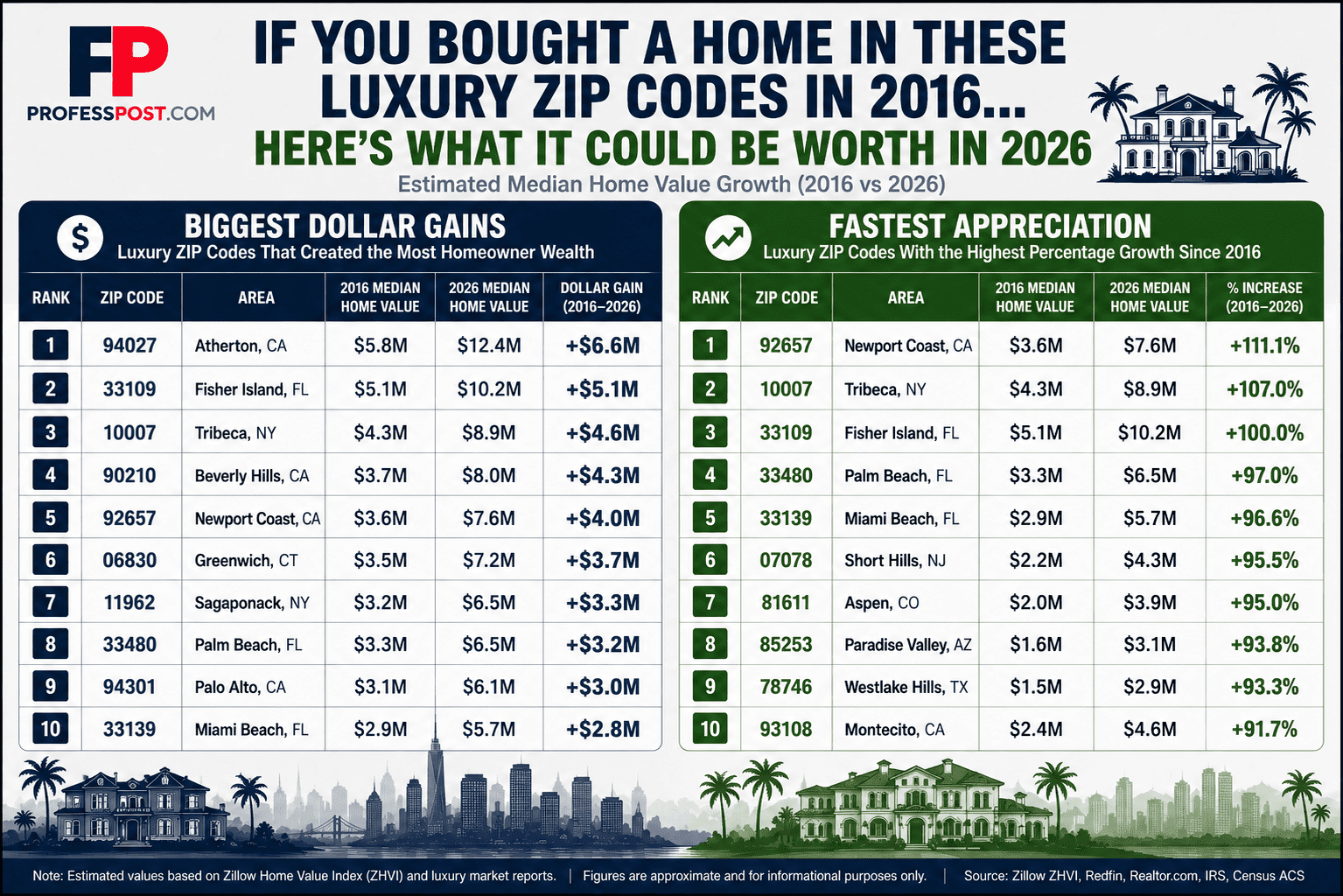
In raw dollar terms, a homeowner in certain luxury ZIP codes may have added several million dollars in estimated home equity over 10 years.
That kind of appreciation reflects how concentrated wealth has become in America’s top-tier housing markets. If you’re curious how these neighborhoods compare with the country’s overall wealthiest enclaves, see our breakdown of America’s richest ZIP codes in 2026.
Top Estimated Dollar Winners
- 94027 (Atherton, CA): +$6M+
- 33109 (Fisher Island, FL): +$5M+
- 10007 (Tribeca, NY): +$4M+
- 90210 (Beverly Hills, CA): +$4M+
- 92657 (Newport Coast, CA): +$4M+
These gains reflect something broader than luxury home appreciation—they reflect where wealth has increasingly concentrated in modern America.
Fastest Appreciation
Raw dollars tell one story, but percentage growth reveals where luxury markets accelerated fastest.
Florida and select Sun Belt luxury enclaves posted some of the strongest relative gains, helped by migration from high-tax states, increased demand from affluent remote workers, and limited premium inventory.
Top Percentage Growth Leaders
- 92657 (Newport Coast, CA): +111%
- 10007 (Tribeca, NY): +107%
- 33109 (Fisher Island, FL): +100%
- 33480 (Palm Beach, FL): +97%
- 33139 (Miami Beach, FL): +96%
This helps explain why certain markets became magnets for wealthy households over the last decade.
What Drove These Gains?
1. Wealth Migration
Affluent households increasingly relocated toward lower-tax, lifestyle-focused markets like Florida, Arizona, and Texas.
2. Tech Wealth Explosion
Silicon Valley continued creating massive liquidity events, reinforcing ultra-luxury housing demand in markets like Atherton and Palo Alto.
3. Limited Inventory
Prime luxury neighborhoods simply don’t expand much. Scarcity supports pricing power.
4. Asset Inflation
Luxury housing often behaves like a wealth-preservation asset, especially during inflationary periods.
How Rich Is “Rich” in America Today?
Luxury real estate appreciation also reshapes how Americans think about wealth. A six-figure salary that feels significant nationally may look very different in elite housing markets.
For perspective, see our analysis of where a $150K salary still feels rich in America and our breakdown of what it takes to be considered rich in America’s biggest cities.
Final Takeaway
Buying luxury real estate in the right ZIP code in 2016 may have generated millions in estimated housing wealth by 2026.
While most Americans experienced rising housing costs as buyers, existing owners in elite markets often saw the opposite: extraordinary wealth creation through appreciation.
That divide helps explain why America’s wealth map looks increasingly concentrated in a relatively small number of ultra-premium ZIP codes.
Disclaimer: Values shown are estimated based on luxury housing market trends, public housing data, and market comparisons. Figures are approximate and intended for informational/editorial purposes.