How Much Rent Increased in America’s Biggest Cities Since 2016


The U.S. Cities Where Rent Increased the Most Since 2016
Over the last decade, rising rents have become one of the biggest financial pressures facing American households. While inflation, population growth, and housing shortages affected much of the country, some cities experienced dramatically larger rent increases than others.
Using estimated median asking rent trends between 2016 and 2026, we analyzed major U.S. cities to see where renters experienced the largest increases over the past ten years.
The results reveal a clear pattern: Sun Belt cities dominated the rankings, with Florida and Texas metros posting some of the most dramatic rent growth in America.
Florida Became Ground Zero for Rent Growth
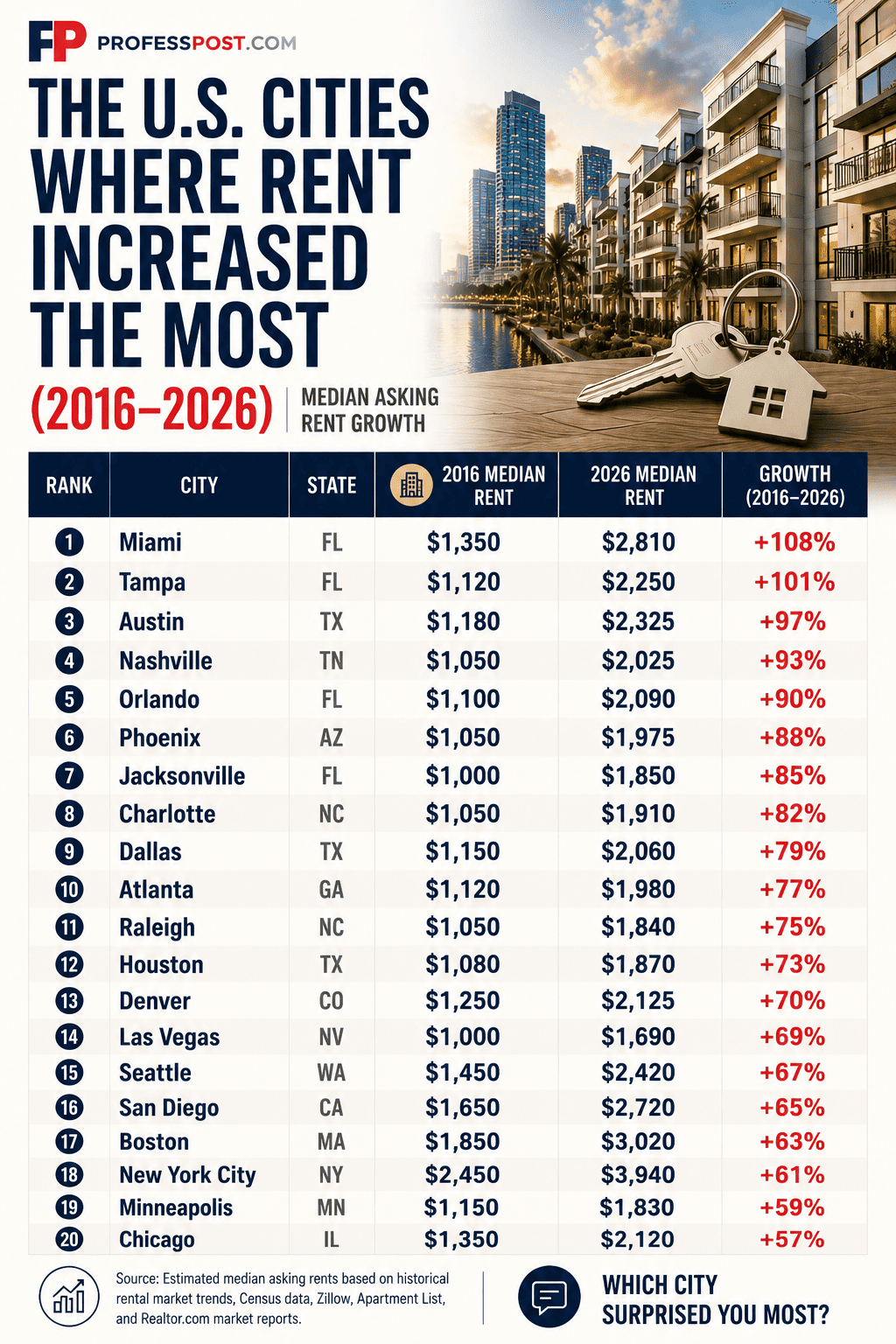
Miami ranked first in our analysis, with estimated median asking rents rising from roughly $1,350 in 2016 to $2,810 in 2026 — an increase of 108%.
Tampa and Orlando also ranked near the top, reflecting how migration, population growth, and limited housing supply transformed Florida’s rental market during the decade.
The state’s appeal to remote workers, retirees, investors, and high-income households helped fuel demand while construction struggled to fully keep pace.
Top 5 Cities for Rent Growth
- Miami (+108%)
- Tampa (+101%)
- Austin (+97%)
- Nashville (+93%)
- Orlando (+90%)
Several housing markets in Florida remain among the fastest-changing in the country, driven by continued population inflows and strong demand for rental housing.
Texas Cities Saw Massive Growth
Austin ranked third overall with estimated rents nearly doubling over the decade.
Dallas and Houston also posted major increases as Texas continued attracting businesses, workers, and new residents from higher-cost states.
Despite significant apartment construction, demand remained strong enough to push rents substantially higher throughout much of the period. Recent affordability improvements in Austin suggest supply growth can eventually slow rent inflation when enough housing is added to the market.
The Housing Affordability Challenge
Rent growth has become one of the biggest reasons many Americans feel financially squeezed despite rising incomes.
In many cities, rent costs increased faster than wages, reducing purchasing power and making it harder for households to save for homeownership.
That trend connects directly to broader affordability issues highlighted in our analysis of America’s largest metro areas ranked by housing affordability.
Many of the cities with the fastest rent growth also experienced major increases in home prices, creating affordability pressure for both renters and buyers.
Income Growth Didn’t Always Keep Up
Some cities on this list also experienced strong household income growth over the last decade.
Markets such as Austin, Raleigh, Nashville, Charlotte, and Miami benefited from expanding job markets and population growth.
However, rising incomes often failed to fully offset rising housing costs.
For more context, see our ranking of U.S. cities where household income grew the most between 2016 and 2026.
What It Means for Wealth Building
Housing inflation affects more than monthly budgets.
Higher rents make it harder for renters to save for down payments, invest, or build long-term wealth. Meanwhile, homeowners in many fast-growing markets often benefited from substantial property appreciation.
Our analysis of America’s richest ZIP codes shows how dramatically housing wealth expanded in some of the country’s most valuable real estate markets during the same period.
The gap between renters and homeowners has become an increasingly important part of America’s wealth divide.
When Does a High Income Actually Feel Rich?
Rising rents also help explain why many six-figure earners still feel financially stretched.
In expensive housing markets, even high salaries can be consumed by rent, transportation, taxes, and everyday living expenses.
Our analysis of what it takes to be considered rich across America’s biggest cities highlights how dramatically income expectations vary depending on location.
Full Rankings: Estimated Rent Growth (2016–2026)
| Rank | City | 2016 Median Rent | 2026 Median Rent | Growth |
|---|---|---|---|---|
| 1 | Miami | $1,350 | $2,810 | +108% |
| 2 | Tampa | $1,120 | $2,250 | +101% |
| 3 | Austin | $1,180 | $2,325 | +97% |
| 4 | Nashville | $1,050 | $2,025 | +93% |
| 5 | Orlando | $1,100 | $2,090 | +90% |
| 6 | Phoenix | $1,050 | $1,975 | +88% |
| 7 | Jacksonville | $1,000 | $1,850 | +85% |
| 8 | Charlotte | $1,050 | $1,910 | +82% |
| 9 | Dallas | $1,150 | $2,060 | +79% |
| 10 | Atlanta | $1,120 | $1,980 | +77% |
| 11 | Raleigh | $1,050 | $1,840 | +75% |
| 12 | Houston | $1,080 | $1,870 | +73% |
| 13 | Denver | $1,250 | $2,125 | +70% |
| 14 | Las Vegas | $1,000 | $1,690 | +69% |
| 15 | Seattle | $1,450 | $2,420 | +67% |
| 16 | San Diego | $1,650 | $2,720 | +65% |
| 17 | Boston | $1,850 | $3,020 | +63% |
| 18 | New York City | $2,450 | $3,940 | +61% |
| 19 | Minneapolis | $1,150 | $1,830 | +59% |
| 20 | Chicago | $1,350 | $2,120 | +57% |
Final Takeaway
The past decade reshaped America’s rental market.
While nearly every major city experienced rising housing costs, Sun Belt metros such as Miami, Tampa, Austin, Nashville, and Orlando saw some of the most dramatic rent increases in the country.
For millions of renters, the challenge is no longer just finding housing — it’s keeping pace with how quickly housing costs continue to rise.
Disclaimer: Rent figures shown are estimated median asking rents based on historical rental market trends, housing data, Census trends, and publicly available market reports. Values are intended for informational and editorial purposes only.