If You Bought a Home in These NYC Neighborhoods in 2016, Here’s What It Could Be Worth Today


New York City real estate has created enormous wealth over the past decade, but not every neighborhood benefited equally. While luxury areas like SoHo and the Upper East Side continued climbing, several neighborhoods in Brooklyn and Queens delivered some of the strongest appreciation rates in the city.
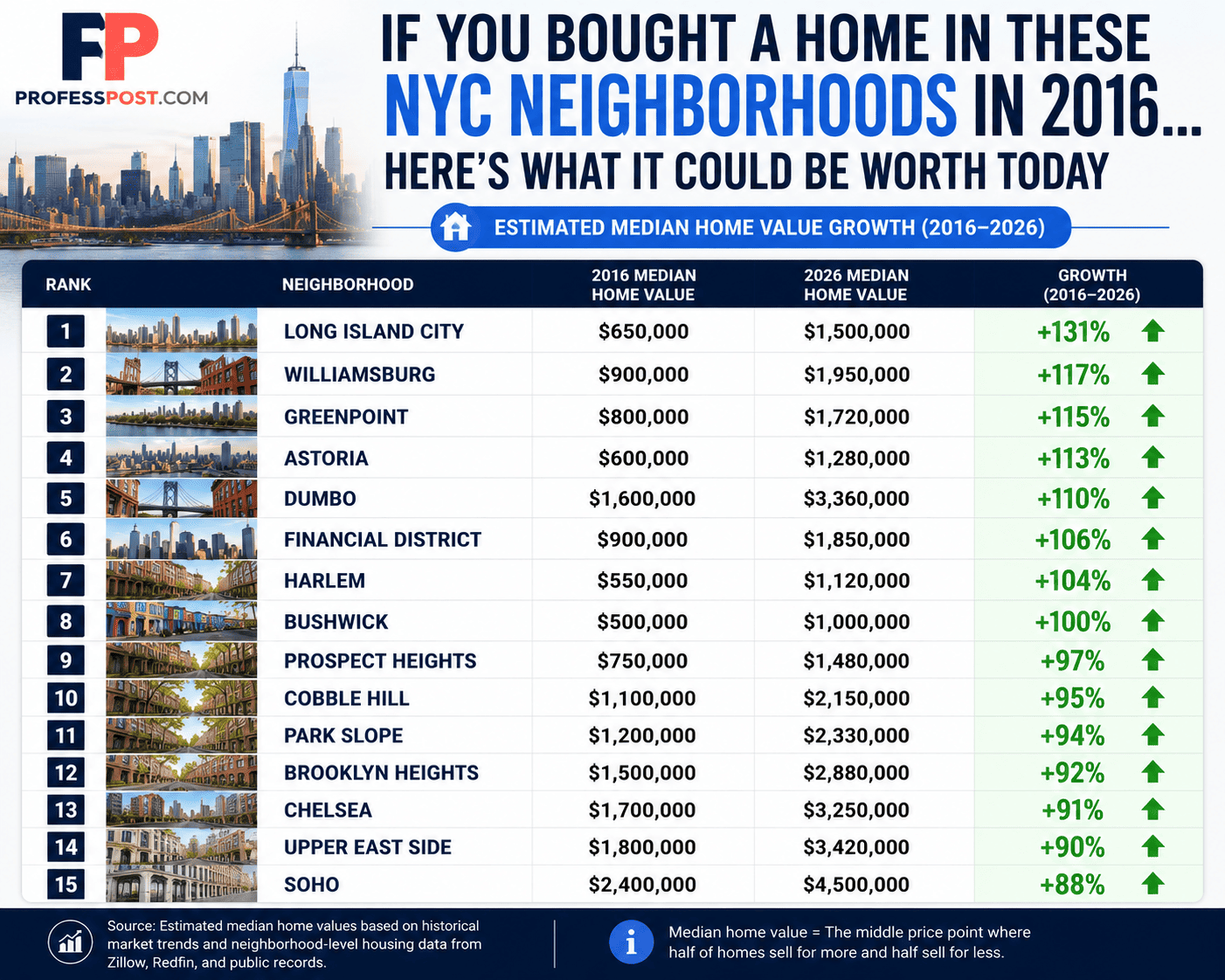
Using estimated neighborhood-level housing trends between 2016 and 2026, we analyzed how median home values changed across NYC’s most recognizable neighborhoods. The results reveal where homeowners may have seen the largest increases in housing wealth over the last ten years.
Other NYC Neighborhoods That Saw Significant Growth
While the neighborhoods featured in our infographic posted some of the strongest estimated gains, they were far from the only areas that experienced substantial appreciation over the last decade.
Additional neighborhoods that recorded notable housing value growth include Tribeca, West Village, Greenwich Village, NoMad, Gramercy, Murray Hill, Kips Bay, Hudson Yards, Lower East Side, East Village, Upper West Side, Battery Park City, Roosevelt Island, Carroll Gardens, Boerum Hill, Red Hook, Clinton Hill, Fort Greene, Crown Heights, Bedford-Stuyvesant, Ridgewood, Sunnyside, Forest Hills, Rego Park, Jackson Heights, and Riverdale.
Together, these neighborhoods illustrate how widespread housing appreciation became across New York City between 2016 and 2026. While some areas benefited from luxury demand and limited inventory, others experienced growth driven by new development, improved amenities, changing demographics, and expanding transit access.
| Rank | Neighborhood | 2016 Median Home Value | 2026 Median Home Value | Growth (2016–2026) |
|---|---|---|---|---|
| 1 | Long Island City | $650,000 | $1,500,000 | +131% |
| 2 | Williamsburg | $900,000 | $1,950,000 | +117% |
| 3 | Greenpoint | $800,000 | $1,720,000 | +115% |
| 4 | Astoria | $600,000 | $1,280,000 | +113% |
| 5 | DUMBO | $1,600,000 | $3,360,000 | +110% |
| 6 | Financial District | $900,000 | $1,850,000 | +106% |
| 7 | Harlem | $550,000 | $1,120,000 | +104% |
| 8 | Bushwick | $500,000 | $1,000,000 | +100% |
| 9 | Prospect Heights | $750,000 | $1,480,000 | +97% |
| 10 | Cobble Hill | $1,100,000 | $2,150,000 | +95% |
| 11 | Park Slope | $1,200,000 | $2,330,000 | +94% |
| 12 | Brooklyn Heights | $1,500,000 | $2,880,000 | +92% |
| 13 | Chelsea | $1,700,000 | $3,250,000 | +91% |
| 14 | Upper East Side | $1,800,000 | $3,420,000 | +90% |
| 15 | SoHo | $2,400,000 | $4,500,000 | +88% |
| 16 | Tribeca | $2,800,000 | $5,200,000 | +86% |
| 17 | West Village | $2,100,000 | $3,850,000 | +83% |
| 18 | Greenwich Village | $2,000,000 | $3,650,000 | +83% |
| 19 | NoMad | $1,700,000 | $3,100,000 | +82% |
| 20 | Battery Park City | $1,500,000 | $2,700,000 | +80% |
| 21 | Gramercy | $1,450,000 | $2,600,000 | +79% |
| 22 | Hudson Yards | $1,800,000 | $3,200,000 | +78% |
| 23 | Murray Hill | $1,100,000 | $1,950,000 | +77% |
| 24 | Kips Bay | $1,050,000 | $1,850,000 | +76% |
| 25 | Carroll Gardens | $1,100,000 | $1,930,000 | +75% |
| 26 | Boerum Hill | $1,050,000 | $1,830,000 | +74% |
| 27 | Fort Greene | $950,000 | $1,650,000 | +74% |
| 28 | Clinton Hill | $900,000 | $1,550,000 | +72% |
| 29 | Sunnyside | $700,000 | $1,190,000 | +70% |
| 30 | Forest Hills | $800,000 | $1,350,000 | +69% |
| 31 | Jackson Heights | $650,000 | $1,090,000 | +68% |
| 32 | Rego Park | $720,000 | $1,200,000 | +67% |
| 33 | Lower East Side | $1,000,000 | $1,650,000 | +65% |
| 34 | East Village | $1,050,000 | $1,720,000 | +64% |
| 35 | Upper West Side | $1,600,000 | $2,600,000 | +63% |
| 36 | Crown Heights | $800,000 | $1,290,000 | +61% |
| 37 | Bedford-Stuyvesant | $750,000 | $1,200,000 | +60% |
| 38 | Ridgewood | $680,000 | $1,080,000 | +59% |
| 39 | Roosevelt Island | $900,000 | $1,420,000 | +58% |
| 40 | Riverdale | $850,000 | $1,320,000 | +55% |
The Neighborhoods That Saw the Fastest Growth
Long Island City topped our rankings, with estimated median home values rising from roughly $650,000 in 2016 to $1.5 million in 2026. Massive residential development, waterfront investment, and proximity to Manhattan helped transform the neighborhood into one of New York’s hottest housing markets.
Williamsburg and Greenpoint also continued their remarkable growth stories. Once viewed as emerging Brooklyn markets, both neighborhoods became highly desirable destinations for professionals, families, and investors seeking access to Manhattan without Manhattan prices.
Astoria ranked among the city’s strongest performers as well, benefiting from improved amenities, strong transit access, and relative affordability compared to nearby Manhattan neighborhoods.
Top Estimated Appreciation Leaders
- Long Island City (+131%)
- Williamsburg (+117%)
- Greenpoint (+115%)
- Astoria (+113%)
- DUMBO (+110%)
- Financial District (+106%)
- Harlem (+104%)
- Bushwick (+100%)
Brooklyn’s Continued Rise
Brooklyn remained one of the biggest wealth-creation stories in New York real estate.
Neighborhoods such as Park Slope, Prospect Heights, Cobble Hill, Brooklyn Heights, Carroll Gardens, Boerum Hill, and DUMBO all experienced substantial appreciation during the decade.
The combination of brownstone housing stock, strong schools, vibrant retail corridors, and limited inventory helped push prices higher throughout many parts of the borough.
In several cases, Brooklyn neighborhoods that were once viewed as affordable alternatives to Manhattan now command prices comparable to some of Manhattan’s most established residential districts.
Manhattan Still Commands a Premium
Although some outer-borough neighborhoods posted faster growth rates, Manhattan remained home to many of the city’s highest-valued properties.
SoHo, Chelsea, Tribeca, the Upper East Side, the Upper West Side, Greenwich Village, West Village, NoMad, Gramercy, and Battery Park City all continued attracting affluent buyers throughout the decade.
Many of these neighborhoods started from a much higher price base, making triple-digit appreciation more difficult to achieve. Even so, homeowners often gained millions in estimated housing wealth.
Readers interested in luxury housing trends nationwide may also enjoy our analysis of America’s luxury ZIP codes and their estimated home value growth since 2016.
Queens Continues to Emerge
Queens produced some of the city’s most impressive appreciation stories.
Beyond Long Island City and Astoria, neighborhoods such as Sunnyside, Forest Hills, Rego Park, and Jackson Heights benefited from growing demand among buyers priced out of Manhattan and parts of Brooklyn.
Improved transportation access and ongoing residential development helped increase demand throughout western Queens in particular.
Housing Wealth vs Income Growth
One reason these gains stand out is that home values often increased faster than local incomes.
Our analysis of NYC neighborhoods where rent increased faster than income highlights how affordability pressures have intensified across many parts of the city.
At the same time, some neighborhoods experienced significant earnings growth. See our breakdown of NYC neighborhoods where household income increased the most over the past decade.
The gap between income growth and housing appreciation continues to shape the city’s affordability challenges.
What Can Buyers Afford Today?
As prices climbed, affordability became increasingly neighborhood-dependent.
A salary that may feel substantial elsewhere in the country can go much less far in New York City. For example, our analysis of what a $250,000 salary can actually afford across NYC neighborhoods shows how dramatically purchasing power varies from one area to another.
Property taxes also remain an important consideration for homeowners. Learn more in our guide to NYC property taxes in 2026.
Final Takeaway
If you purchased a home in the right NYC neighborhood in 2016, the last decade may have generated extraordinary housing wealth.
While Manhattan’s luxury districts continued commanding some of the city’s highest values, several neighborhoods in Brooklyn and Queens delivered the fastest appreciation rates. Long Island City, Williamsburg, Greenpoint, Astoria, and DUMBO emerged as some of the strongest performers, reflecting how New York’s real estate landscape has evolved over the past ten years.
Disclaimer: Home values shown are estimated median values based on historical market trends, neighborhood housing data, and public real estate sources. Figures are intended for informational and editorial purposes only.