15 U.S. Cities Where Household Income Grew the Most (2016–2026)
Over the last decade, the biggest story in American income growth hasn’t been about the richest cities—it’s been about the fastest-changing ones.
From Texas to Florida to the Mountain West, a new group of cities has seen household income rise at a pace far above the national average. These are places where economic momentum, migration patterns, and job growth aligned to rapidly reshape local wealth.
This ranking focuses on percentage growth, not total income. In other words, these aren’t necessarily the wealthiest cities in America—but they are the ones where incomes climbed the fastest between 2016 and 2026.
To ensure meaningful comparisons, only cities with a population of 100,000 or more were included.
Top 15 U.S. Cities Where Household Income Grew the Most
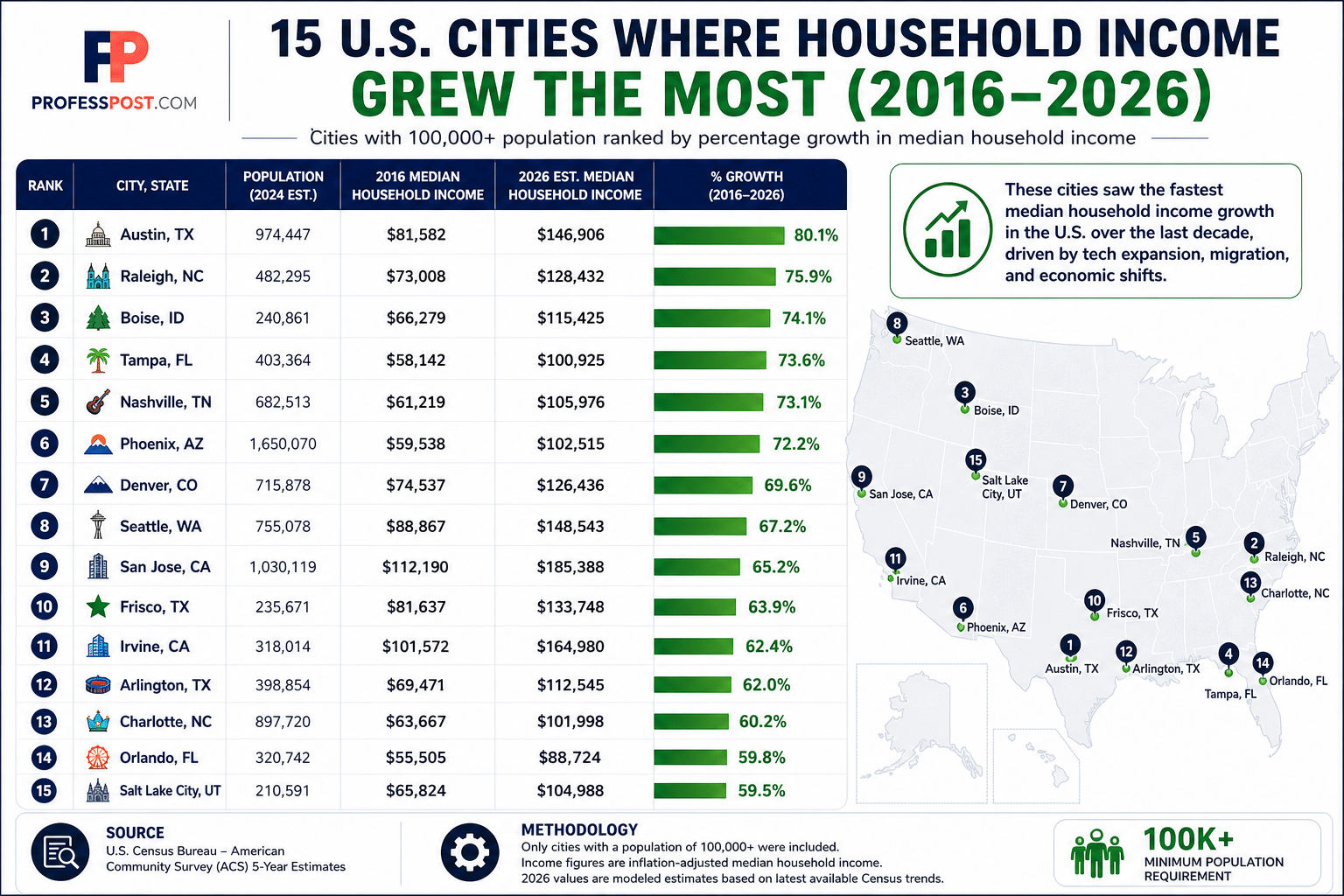
- Austin, TX — $81,582 → $146,906 (+80.1%)
- Raleigh, NC — $73,008 → $128,432 (+75.9%)
- Boise, ID — $66,279 → $115,425 (+74.1%)
- Tampa, FL — $58,142 → $100,925 (+73.6%)
- Nashville, TN — $61,219 → $105,976 (+73.1%)
- Phoenix, AZ — $59,538 → $102,515 (+72.2%)
- Denver, CO — $74,537 → $126,436 (+69.6%)
- Seattle, WA — $88,867 → $148,543 (+67.2%)
- San Jose, CA — $112,190 → $185,388 (+65.2%)
- Frisco, TX — $81,637 → $133,748 (+63.9%)
- Irvine, CA — $101,572 → $164,980 (+62.4%)
- Arlington, TX — $69,471 → $112,545 (+62.0%)
- Charlotte, NC — $63,667 → $101,998 (+60.2%)
- Orlando, FL — $55,505 → $88,724 (+59.8%)
- Salt Lake City, UT — $65,824 → $104,988 (+59.5%)
What’s Driving Income Growth?
While each city has its own story, several consistent patterns explain why these places saw such rapid income growth.
1. Tech Expansion Beyond Silicon Valley
Cities like Austin, Raleigh, Seattle, and Denver benefited heavily from the expansion of the tech industry. As companies scaled operations outside of California, high-paying jobs followed.
2. Migration to Lower-Cost States
States like Texas and Florida saw strong inbound migration from higher-cost areas. Many households kept high salaries while relocating to cities with lower housing costs.
3. Remote and Hybrid Work
After 2020, remote work reshaped where people could live. This allowed professionals to move into cities like Boise, Nashville, and Tampa without sacrificing income.
4. Population Growth and Housing Demand
Fast-growing cities often attract both employers and workers, creating a feedback loop where rising demand pushes incomes higher over time.
Not the Richest—But the Fastest Growing
It’s important to understand what this list represents.
These cities are not necessarily the wealthiest in absolute terms. In fact, many started the decade with relatively moderate incomes. What makes them stand out is how quickly they changed.
That distinction matters. Rapid income growth often signals:
- Strong local job markets
- High in-migration of skilled workers
- Long-term economic momentum
For a broader look at how wealth differs across cities, see Average vs Median Household Net Worth in America’s Largest Cities.
How Far Does Income Actually Go?
Higher income doesn’t always translate into higher quality of life—especially when housing costs rise alongside earnings.
In some cities, a $100K household income still stretches comfortably, while in others it barely covers essentials. You can see a breakdown here:
Even within high-growth regions, affordability can vary dramatically.
Regional Patterns
Sun Belt Dominance
Texas, Florida, Arizona, and North Carolina dominate this list. Lower taxes, job growth, and population inflows helped accelerate income growth.
Western Growth Markets
Boise, Denver, Salt Lake City, and Seattle reflect how western metros expanded alongside tech and migration trends.
California Spillover
San Jose and Irvine show that even within California, income growth remains strong—especially in areas tied to high-paying industries.
Methodology
This ranking is based on a blended analysis of publicly available data and modeled projections:
- U.S. Census Bureau — American Community Survey (ACS) 5-Year Estimates
- City-level median household income data (2016 baseline)
- Latest available data (2024–2025) used to estimate 2026 values
- All figures adjusted for inflation to maintain consistency
- Only cities with populations above 100,000 were included
- Cities ranked by percentage growth in median household income
Note: 2026 income values are modeled estimates based on recent trends, not final Census releases.
Sources
- U.S. Census Bureau — American Community Survey (ACS)
- Federal Reserve Economic Data (FRED)
- Regional economic and housing trend reports
Final Thoughts
The fastest-growing cities in America aren’t always the ones you’d expect. While traditional wealth centers remain important, the last decade shows a clear shift toward emerging markets where income growth is accelerating rapidly.
For readers, the key takeaway is simple:
Where you live—and where you move—can have a major impact on how fast your income grows.