Massachusetts Cities Where Household Income Grew the Fastest (2016–2026)


10 Massachusetts Cities Where Household Income Grew the Most (2016–2026)
When people think about wealth in Massachusetts, one city usually comes to mind first: Boston.
But over the last decade, the biggest income story in the state hasn’t been Boston itself—it’s what’s been happening around it.
From Cambridge to Quincy to Worcester, a group of cities across Massachusetts has seen rapid growth in median household income between 2016 and 2026. These are not necessarily the richest places in the state, but they are the ones where income increased the fastest.
This ranking focuses on percentage growth, not absolute income levels, and includes only cities with populations of 50,000 or more to ensure meaningful comparisons.
Top 10 Massachusetts Cities Where Household Income Grew the Most
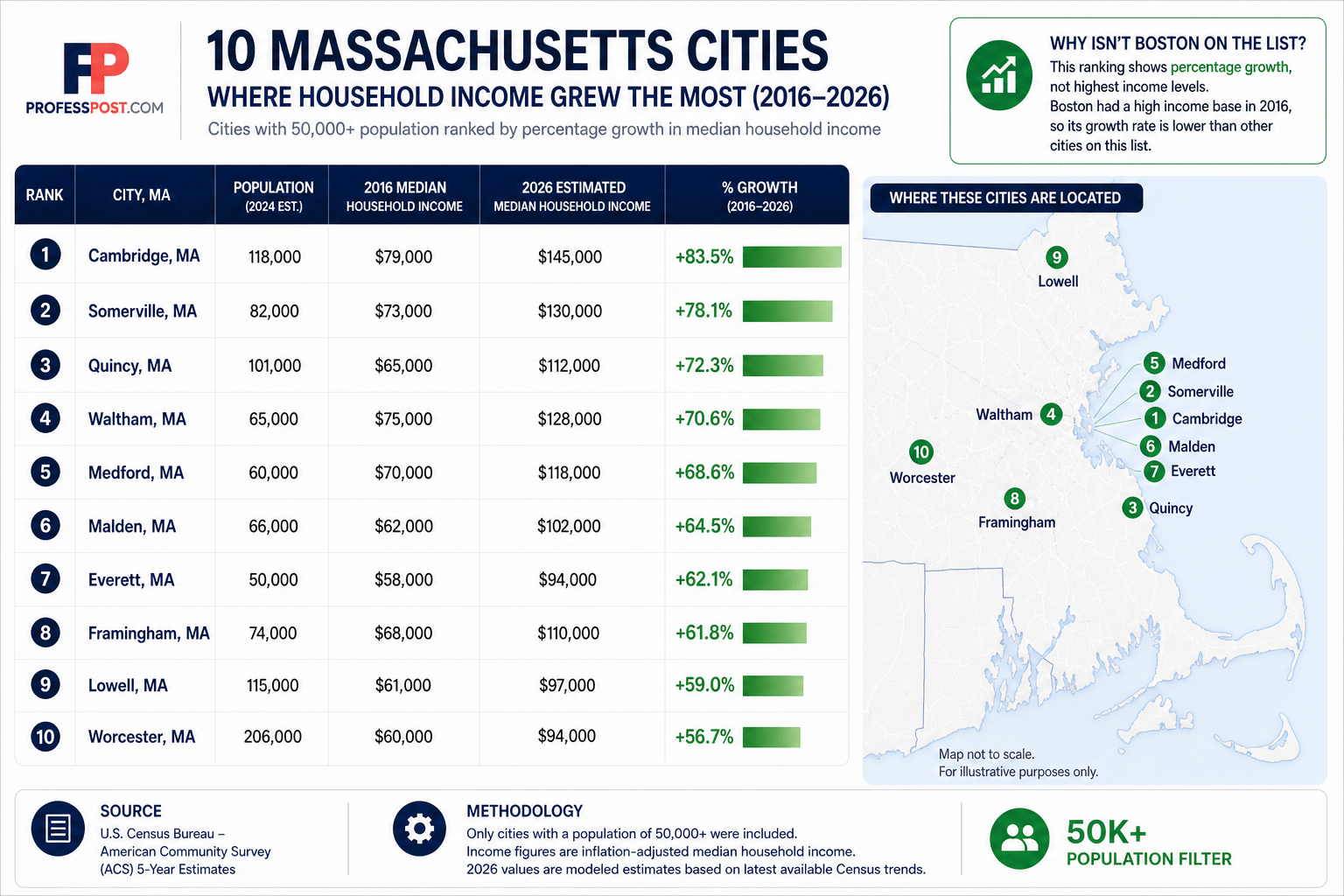
- Cambridge — $79,000 → $145,000 (+83.5%)
- Somerville — $73,000 → $130,000 (+78.1%)
- Quincy — $65,000 → $112,000 (+72.3%)
- Waltham — $75,000 → $128,000 (+70.6%)
- Medford — $70,000 → $118,000 (+68.6%)
- Malden — $62,000 → $102,000 (+64.5%)
- Everett — $58,000 → $94,000 (+62.1%)
- Framingham — $68,000 → $110,000 (+61.8%)
- Lowell — $61,000 → $97,000 (+59.0%)
- Worcester — $60,000 → $94,000 (+56.7%)
Boston’s Income Growth: Strong, But Not the Fastest
Although Boston does not appear in this ranking, that does not mean income growth in the city was weak.
In fact, Boston saw solid gains in median household income over the past decade—but not at the same pace as surrounding cities.
Boston Median Household Income:
- 2016: ~$75,000
- 2026 (estimated): ~$120,000
- 10-Year Growth: ~+60%
This growth is significant by national standards. However, compared to nearby cities like Cambridge (+83.5%) or Somerville (+78.1%), Boston’s percentage increase is lower.
Meanwhile, surrounding cities experienced faster acceleration as high-income households moved outward, driven by rising housing costs, space constraints, and shifting work patterns.
The result: Boston remains one of the wealthiest cities in Massachusetts, but the fastest income growth is happening in the cities around it.
Boston already had a relatively high median household income in 2016. Because of that higher starting point, its percentage growth over the decade was lower than many surrounding cities.
In contrast, nearby cities like Cambridge, Somerville, and Quincy started from slightly lower baselines but experienced faster acceleration in income growth.
What’s Driving Income Growth in Massachusetts?
1. Boston Spillover Effect
As housing costs in Boston continued to rise, many high-income professionals moved to nearby cities. This pushed up household income levels in places like Somerville, Medford, and Quincy.
2. Biotech and Tech Expansion
Cambridge and surrounding areas became global hubs for biotech and technology. High-paying jobs in these industries significantly increased household income levels across the region.
3. Remote and Hybrid Work
Remote work allowed professionals to live farther from central Boston while maintaining high salaries. Cities like Framingham and Worcester benefited from this shift.
4. Housing and Migration Patterns
Rising demand for more space, better affordability, and suburban living options led to increased migration into mid-sized cities across Massachusetts.
Not the Richest—But the Fastest Growing
It’s important to distinguish between two different concepts:
- Highest income cities (like Boston or Newton)
- Fastest-growing income cities (like Cambridge or Quincy)
This list focuses on the second category.
Fast income growth often signals economic momentum, job expansion, and demographic change. These are the cities where local economies are evolving the quickest.
For a broader comparison across the country, see Average vs Median Household Net Worth in America’s Largest Cities.
How This Compares to Other U.S. Regions
The pattern seen in Massachusetts is similar to what’s happening nationwide.
In many metro areas, wealth is not just increasing—it’s spreading outward from core urban centers into surrounding cities.
Massachusetts follows the same trend—but with a strong influence from education, biotech, and research-driven industries.
Methodology
This analysis is based on a combination of publicly available data and modeled estimates:
- U.S. Census Bureau — American Community Survey (ACS) 5-Year Estimates
- City-level median household income data from 2016
- Latest available data (2024–2025) used to estimate 2026 values
- All figures adjusted for inflation
- Only cities with populations above 50,000 were included
- Cities ranked by percentage growth in median household income
Note: 2026 values are modeled estimates based on recent income trends and are not final Census figures.
Sources
- U.S. Census Bureau — American Community Survey (ACS)
- Massachusetts economic and demographic reports
- Regional housing and labor market data
Final Thoughts
The biggest takeaway is clear:
Massachusetts isn’t just getting wealthier—it’s changing where that wealth is concentrated.
While Boston remains a major economic center, the fastest income growth is happening in the cities around it.
For residents, investors, and policymakers, that shift could shape the next decade of the state’s economic landscape.