$100K in San Francisco: The Neighborhoods Where It Still Works in 2026


Where a $100K Salary Still Works in San Francisco (By Neighborhood, 2026)
Earning $100,000 a year in San Francisco sounds solid until you start looking at rent.
In one of the most expensive housing markets in the U.S., that income can either feel manageable or surprisingly tight, depending entirely on where you live. Neighborhood choice isn’t just a lifestyle decision here it’s a financial one.
This guide breaks down where a $100K salary still holds up in San Francisco, and where it starts to fall apart.
Why $100K Doesn’t Go as Far as You Think
Once taxes are taken out, a $100K salary in California typically leaves you with around $6,000–$6,400 per month.
From there, housing quickly dominates your budget. In many central areas, rents regularly push past $4,000 meaning more than half of your income can disappear before covering anything else.
That’s the key issue: it’s not the salary that changed — it’s the cost structure around it.
For a deeper breakdown of how housing compares across areas, see our analysis of
rent-to-income ratios by neighborhood in San Francisco
Neighborhoods Where $100K Still Holds Up
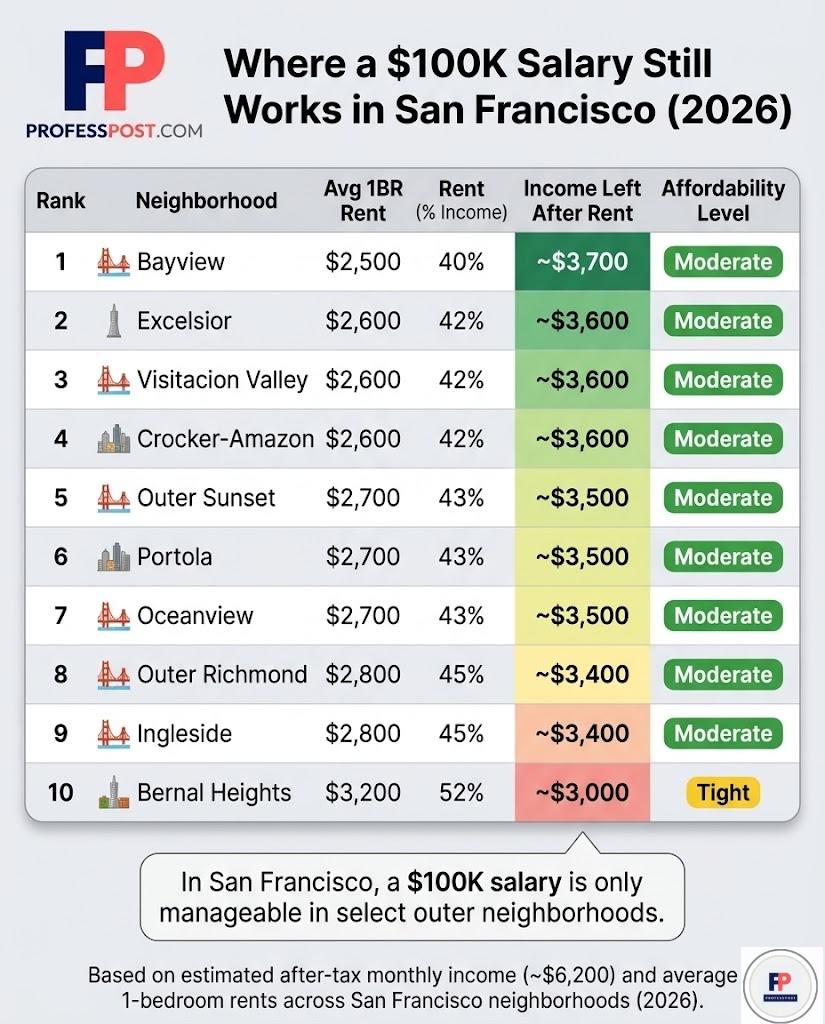
There are still pockets of San Francisco where the numbers make more sense. These neighborhoods offer a better balance between rent and take-home income:
- Outer Sunset
- Outer Richmond
- Excelsior
- Bayview
- Visitacion Valley
- Portola
- Ingleside
- Crocker-Amazon
- Oceanview
- Bernal Heights (select areas)
In these locations, rents typically land in the $2,500–$3,200 range. That still isn’t cheap but it keeps housing closer to half of your income instead of pushing far beyond it.
The result is simple: you retain enough cash flow to handle everyday expenses without constant financial strain.
What You’re Trading Off
There’s a reason these neighborhoods are more affordable.
In most cases, you’re making at least one of these trade-offs:
- Longer commute times
- Fewer high-end amenities
- Less central location
That trade-off is part of the equation in San Francisco. Lower rent rarely comes without some compromise but for many, it’s the only way to make the numbers work.
Where the Budget Breaks Down
In more central or high-demand neighborhoods, affordability shifts quickly.
- SoMa
- Mission District
- Hayes Valley
- Financial District
- Nob Hill
- Marina District
Here, rents often climb into the $3,800–$4,800+ range. At that level, a $100K salary starts to feel stretched especially for anyone trying to live alone.
For many residents, this leads to one of two outcomes: sharing housing or adjusting expectations around lifestyle and savings.
If you’re considering buying instead of renting, the income requirements are even higher. See our breakdown of
income needed to buy a home in San Francisco by neighborhood.
The Real Variable Isn’t Income — It’s Location
One of the biggest takeaways from this analysis is how much location reshapes financial reality.
Two people earning the same salary in the same city can end up with completely different levels of financial flexibility simply because of where they live.
This becomes even more clear when comparing high-income areas. For context, explore
San Francisco’s richest neighborhoods ranked by income and home prices.
What “Affordable” Actually Means Here
In most U.S. cities, spending 30% of income on housing is considered the standard benchmark.
In San Francisco, that number is rarely realistic.
Instead, “affordable” often means staying closer to 45%–50% of income not because it’s ideal, but because it’s the best available option in the current market.
Final Thoughts
A $100K salary in San Francisco still works but only under specific conditions.
It requires choosing the right neighborhood, accepting certain trade-offs, and staying mindful of overall spending.
The difference between “manageable” and “overwhelming” often comes down to a few hundred dollars in monthly rent.
And in a city like San Francisco, that difference can change everything.
Methodology
This analysis is based on estimated 2026 rental and income data across San Francisco neighborhoods, focusing on single earners with a $100K salary.
- After-tax monthly income estimated at ~$6,200
- Median 1-bedroom rental data by neighborhood
- Rent-to-income ratios used as primary affordability metric
- Supplementary cost estimates for transportation, food, and utilities
Neighborhood selection was based on:
- Rental pricing below the city’s upper-tier averages
- Rent burden generally at or below ~50% of income
- Remaining income sufficient for basic living expenses
- Consistency in non-luxury rental listings
The objective is to reflect realistic living conditions not idealized affordability benchmarks.
Sources
- San Francisco rental market data
- Apartments.com & RentCafe pricing trends
- California tax calculations (federal + state)
- Cost-of-living indices (Numbeo, BLS)