Top 10 NYC Neighborhoods Where a $100K Salary Still Feels Comfortable (2026)

Living on $100K in NYC? These Neighborhoods Make It Possible (2026)
In New York City, a $100,000 salary doesn’t guarantee comfort but in the right neighborhoods, it can still provide a stable and manageable lifestyle.
While NYC is often labeled as one of the most expensive cities in the world, the reality is more nuanced. Housing costs vary dramatically by neighborhood, and that variation directly shapes how far your income actually goes.
This breakdown focuses on where a $100K salary still feels livable even comfortable in 2026, based on rent levels, income share, and remaining disposable income.
If you’ve seen our broader NYC analysis like
what $250K can afford across neighborhoods, this article zooms in on a more common income level — and a much tighter financial reality.
The $100K Reality in NYC
On paper, a $100K salary still looks strong. But in NYC, taxes and housing quickly change that picture.
After federal, state, and city taxes, a $100K income typically translates to around $6,300–$6,700 per month in take-home pay.
From there, rent becomes the defining factor.
In many neighborhoods, housing alone can take up 45%–60% of income far above the recommended 30% threshold. That leaves limited room for savings, investing, or lifestyle flexibility.
This is why location even within the same city plays such a critical role in financial outcomes.
Top 10 NYC Neighborhoods Where $100K Still Works
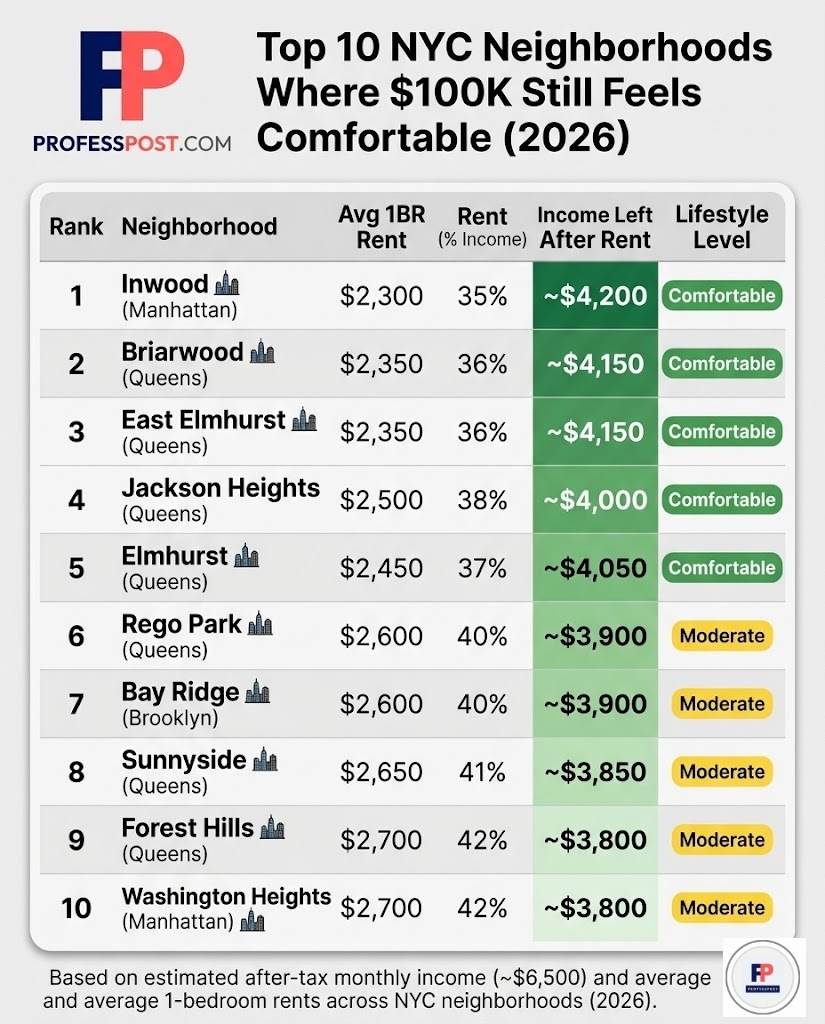
The following neighborhoods offer the best balance between rent levels and remaining income in 2026:
- Inwood (Manhattan)
- Briarwood (Queens)
- East Elmhurst (Queens)
- Jackson Heights (Queens)
- Elmhurst (Queens)
- Rego Park (Queens)
- Forest Hills (Queens)
- Bay Ridge (Brooklyn)
- Sunnyside (Queens)
- Washington Heights (Manhattan)
In these areas, average rents generally fall between $2,300 and $2,700 per month, keeping housing costs closer to 35%–42% of income.
That difference compared to $4,000+ rents in core Manhattan — is what creates a meaningful gap in financial comfort.
Why These Neighborhoods Stand Out
These neighborhoods weren’t selected randomly. Each one meets a specific set of affordability and livability criteria.
1. Rent-to-Income Ratio
We prioritized areas where rent stays below ~42% of take-home income. While still above the traditional 30% guideline, this range is considered more realistic for NYC.
2. Remaining Disposable Income
Neighborhoods were selected where residents can retain roughly $3,800+ per month after rent allowing for transportation, food, and basic savings.
3. Rental Market Stability
We focused on neighborhoods with relatively stable pricing compared to volatile luxury markets.
4. Geographic Trade-Offs
Most selected areas are outside core Manhattan, reflecting a key NYC trade-off: longer commute in exchange for lower housing costs.
For a deeper look at how commuting impacts real costs, see our analysis on
rent vs commute trade-offs in NYC.
The Hidden Cost Factor Most People Miss
Rent is only part of the equation.
Transportation, groceries, utilities, and daily expenses can easily add another $1,500–$2,000 per month depending on lifestyle.
This is why even “affordable” neighborhoods require careful budgeting and why many residents still feel financial pressure despite earning $100K.
For homeowners, the equation shifts even further when factoring in ownership costs like taxes and mortgage payments:
The Bigger Picture: Income vs Location
NYC highlights a broader national trend: income alone no longer defines financial comfort.
Two people earning the same salary can experience completely different lifestyles simply based on where they live.
Even higher incomes don’t fully escape this pattern. As shown in our
$250K NYC breakdown, housing costs continue to scale with location.
This creates a compressed income ladder where traditional benchmarks like $100K no longer carry the same weight they once did.
Final Thoughts
A $100K salary in NYC isn’t what it used to be but it’s not unlivable either.
In the right neighborhoods, it can still support a stable and reasonably comfortable lifestyle.
The key is understanding the trade-offs:
Lower rent often means longer commutes.
Better location often means higher financial pressure.
Finding the balance between those two is what ultimately determines whether $100K feels manageable or overwhelming.
Methodology
This analysis is based on estimated 2026 rental and income data across NYC neighborhoods, focusing specifically on single earners making $100K annually.
- After-tax income estimated at ~$6,500/month (federal, NY state, and NYC local taxes)
- Median 1-bedroom rent estimates by neighborhood
- Rent-to-income ratios used to determine affordability levels
- Estimated non-housing costs including transportation, food, and utilities
Neighborhood Selection Criteria:
- Rent generally below $2,700/month
- Rent burden below ~42% of income
- Minimum ~$3,800 remaining after housing
- Consistent rental demand and price stability
The goal is to reflect real-world affordability — not idealized benchmarks.
Sources
- NYC rental market data
- RentCafe & Apartments.com pricing trends
- NYC housing reports (borough-level data)
- Cost-of-living datasets (Numbeo, BLS)
- NYC tax estimates (federal + state + local)