Income vs. Wealth: Why Earning More Doesn’t Always Mean Being Wealthy

The Wealth Gap Is Not Just About Income
Two households can earn the same salary — and still end up in very different financial positions.
Ask two American households how much they make, and you might get the same answer. Ask how much they own — and how much they owe — and the picture can change dramatically.
That’s because income and wealth are not the same thing.
Income tells us how much money comes into a household. Wealth is what remains after adding up assets and subtracting debts. A household can have a high income without having accumulated much wealth, while another household with a similar income may have spent years building home equity, retirement savings and investments.
Same paycheck. Different balance sheet.
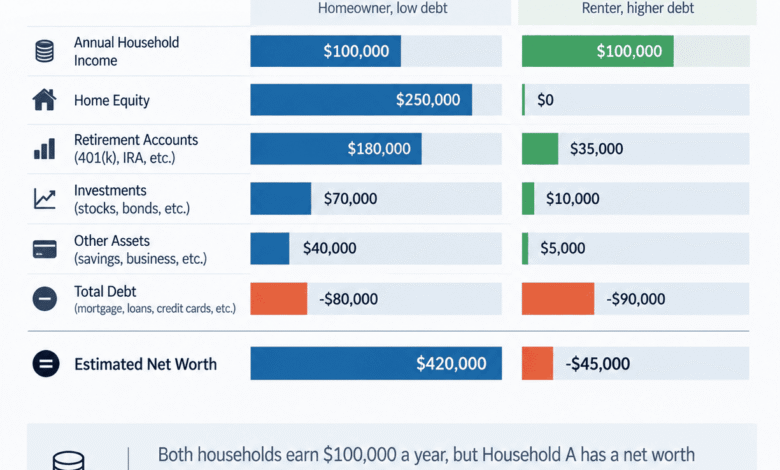
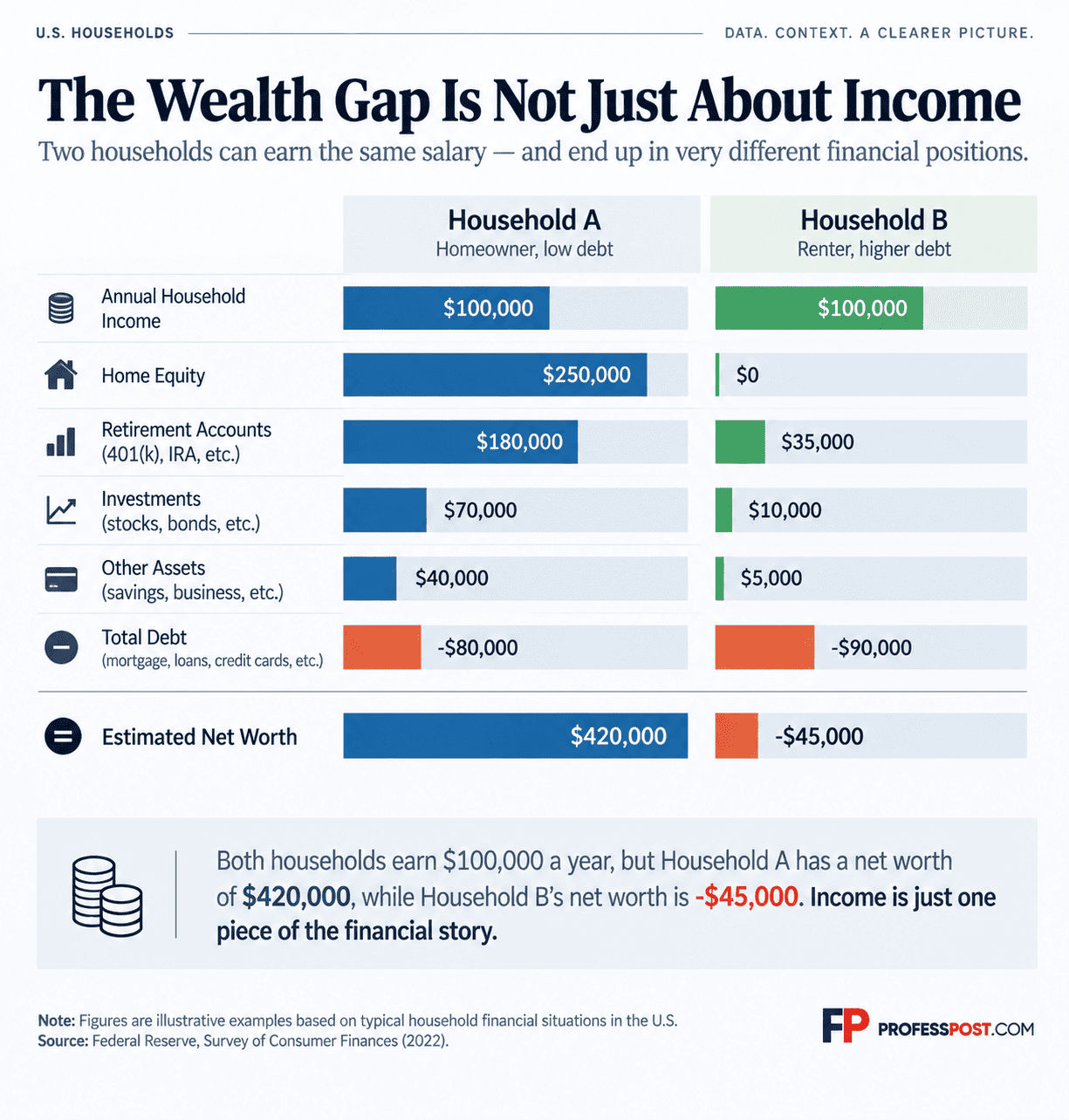
Imagine two households that each earn $100,000 a year.
One owns a home, has built equity, contributes regularly to a 401(k), owns some investments and carries relatively little debt. The other rents, has student loans, has little invested and carries more debt.
Their income is identical. Their net worth isn’t.
That’s why a paycheck alone doesn’t tell us the full story of a household’s financial position.
Homeownership can change the equation
For many Americans, a home is more than a place to live. It can also become one of the largest assets a household owns.
The Federal Reserve reported that 63% of U.S. adults owned a home in 2024. Homeownership was much more common among higher-income adults: 85% of adults with family income of $100,000 or more were homeowners, compared with 35% of those with family income below $50,000.
Over time, mortgage payments can build equity, while changes in home values can also affect a household’s balance sheet. Renters don’t build home equity through their rent payments, although renting can offer other financial and lifestyle advantages.
Retirement savings matter too
The same idea applies to investments and retirement accounts.
In 2024, 61% of U.S. adults reported having a tax-preferred retirement account such as a 401(k), IRA or Roth IRA. But having an account and having substantial savings are two very different things.
Someone who has contributed for decades has had much more time for contributions and investment returns to accumulate than someone who started saving recently.
Time can be one of the most important ingredients in building wealth.
Age changes the picture
Wealth also tends to accumulate over a lifetime.
Older households have generally had more years to purchase homes, pay down mortgages, contribute to retirement plans and invest. That doesn’t mean every older American is wealthy or every younger American is struggling. It simply means that age is an important factor when comparing household wealth.
Debt can erase a lot of assets
Assets aren’t the whole story.
Consider a household that owns a $500,000 home but still owes $400,000 on its mortgage. The home is worth $500,000, but the household has only about $100,000 in home equity.
The same principle applies to student loans, credit-card balances, auto loans and other debt.
This is why economists use net worth rather than simply looking at the value of everything a household owns.
What actually creates the wealth gap?
There isn’t one single answer. Income matters because higher earnings can make it easier to save and invest. But wealth can also depend on whether someone owns a home, has access to a retirement plan, owns investments or a business, carries debt, and has had time to accumulate assets.
- Homeownership: home equity can become a major household asset.
- Investments: stocks, bonds and other assets can grow over time.
- Retirement accounts: regular contributions can compound over decades.
- Debt: liabilities reduce net worth even when income is high.
- Time: starting earlier can give assets more time to grow.
- Access to capital: households do not all have the same opportunity to purchase or invest in assets.
That’s why looking at income alone can miss a major part of the American wealth story. The wealth gap isn’t simply about who earns more each year. It’s also about who owns assets, who carries debt, and how long those assets have had to accumulate.
Same income doesn’t necessarily mean the same financial starting point — or the same financial future.
Federal Reserve Board, Economic Well-Being of U.S. Households in 2024 — housing and savings/investment data.
Federal Reserve Board, Distributional Financial Accounts — U.S. household wealth distribution and asset categories.
U.S. Census Bureau, Wealth of Households: 2023 — household wealth and major asset categories.
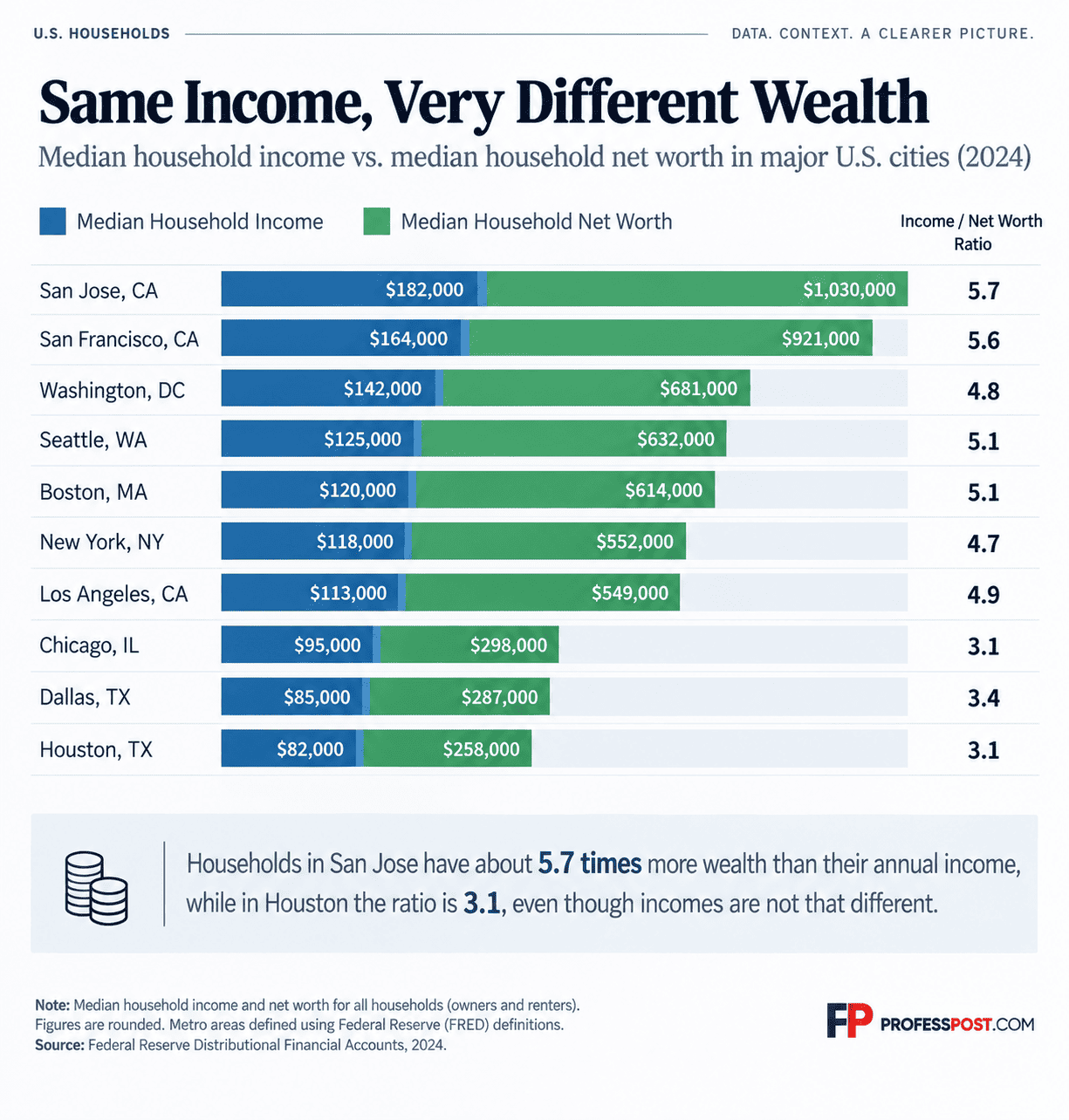
The household graphic uses illustrative figures. The city graphic should retain its own methodology/source note when published.